
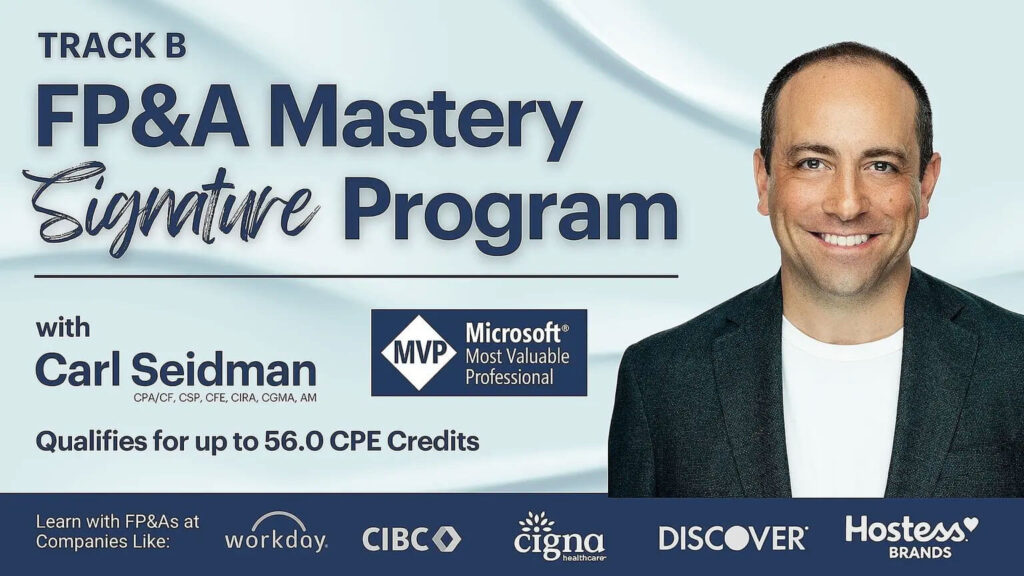
FP&A Mastery Signature Program - Track B
NEW · 26 Weeks · Cohort-based Course
- Master technical + strategic skills that separate elite FP&A leaders from ordinary analysts, landing you better opportunities and visibility
Partial List of Current & Former Clients





Course Overview
FP&A mastery is the premier membership for high-achieving finance professionals
FP&A mastery is the ability to make good, defensible judgments about finance-related decisions, even in the face of high stakes and ambiguity. Leaders who exemplify FP&A mastery skills work at amazing corporations and rapidly-growing entrepreneurial companies.
A common misconception around these finance skills is that they’re something you either have or you don’t and they take many years to attain.
…but that’s not true.
In reality, you can significantly improve your financial planning & analysis (FP&A) influence + critical and strategic thinking ability by reframing your mindset and mastering a handful of core skills: business modeling, financial analysis, empathy and partnership, and effective communication.
The best FP&A professionals don’t think like analysts. They think like advisors. They’re higher-level thinkers. They understand how their insights connect to what others care about. And they’re masterful communicators. They don’t refer to themselves as masters, but they’re always in pursuit of mastery.
People who level up their FP&A technical and non-technical ability tend to get selected for better projects that are more interesting and challenging than those their peers get assigned to. Directors know these exceptional people can handle it and shine. When they succeed, they’re more likely to get promotions, higher pay, and even more exciting opportunities. Work is far more enjoyable and less frustrating because they’re now more capable, confident, and positive. This leads to a more inspiring career and a fulfilling life.
Influence through finance is a skill that can be rapidly developed by changing how you think through learning, application, practice, and ongoing support. This isn’t wishful thinking. This is reality for those who are committed to their own growth.
FP&A MASTERY SIGNATURE PROGRAM OVERVIEW:
In this practical course — full of examples, exercises, templates, models, discussions, and implementation — you will learn and apply the frameworks and techniques of high-performing corporate finance practitioners. We explore dozens of instances of financial models, Excel techniques, analyses, reports, and dashboards to assess what makes them exceptional (or not).
Everything is delivered live, with recordings available to rewatch later (or in some cases, prior cohort videos shared in advance if you’re eager to accelerate). Every hour we meet will challenge you to reflect about finance, modeling, empathy, and communication in ways that most finance people never do in their careers. You will be a live witness to your own transformation of environmental- and self-awareness, experiencing a complete augmentation of how you think.
WHAT IS THE STRUCTURE OF THE PROGRAM:
Whether you learn best through live discussions, on-demand lectures, interactive exercises, real-life business cases and simulations, or peer-to-peer community, the FP&A Mastery Signature Program is a comprehensive hybrid (live AND go-at-your-pace) development experience. It’s the premier membership for financial professionals who want a clearer pathway and more experiential learning for their next level of growth.
It’s built for high-performing finance professionals like you.
TRACK B (OCT 2025 - APR 2026) CONCEPTS COVERED*:
- Budgeting and rolling forecasts
- Financial analysis and ops management
- Advanced Cash Flow Forecasting
- Financial presentations and executive presence
* Registration in the FP&A Mastery Signature Program includes enrollment only in Track B. Attendees who sign up for both programs can receive a waiver code good for 25% of Track B.
If you are interested in Track A, please click the button below.
WHY ENROLL IN THE FP&A MASTERY SIGNATURE PROGRAM VS. INDIVIDUAL COURSES?
Individual courses will immerse you in the content of that single learning experience. The Signature Program gives you access to EVERYTHING across the full learning ecosystem:
- SIGNATURE PROGRAM BENEFITS AND FEATURES:
- All live sessions are recorded (video/audio and transcribed)
- Prior cohort recordings and materials accessible in advance
- Micro-videos and nano-lessons delivered to your inbox
- Access to templates, reports, models, and work files
- Optional projects and capstone business cases
- Learning is NASBA-accredited and CPE eligible
- Periodic live office hours
- Online community
- THE FP&A MASTERY ECOSYSTEM AND FRAMEWORK:
- 30+ live learning experiences taught by domain experts all year round.
- Members can attend all sessions live, watch recent or prior session recordings, and engage with asynchronous content in advance of live sessions.
- Courses are built specifically for FP&A, finance, and accounting professionals in ways that directly support efficiency and advancement at work.
- A community for engagement and collaboration with other FP&A and finance professionals across the L&D ecosystem.
- A network of peers and referral sources to help troubleshoot challenges or make introductions.
WHO ATTENDS THESE PROGRAMS:
Since 2013, Seidman Financial has delivered hundreds of financial programs, workshops, strategic advisory sessions, and LinkedIn Learning courses to over 145,000 FP&A professionals from 25+ industries worldwide. Companies that have enrolled financial analysts, managers, and directors include:
ABM Industries, Accordion, Allscripts, Capitol Broadcasting, CHEP, Choice Hotels, CIBC, Cigna, Cox Enterprises, Crawford & Company, The U.S. Department of Housing and Urban Development, Discover, Energy Transfer, Erie Insurance, EVRAZ, Express Scripts, FS Investments, Genentech, Guy Carpenter, HCPI, Heartland Financial, HP Enterprise, Hormel, Hostess Brands, IGT, Marsh & McLennan, Merck, Michelin, NerdWallet, Outsystems, Rapid7, Rice University, Riveron, Santander, Sloan Valve, Sol Petroleum, Spotify, Telus, Triple-S, UBT, United Technologies, The University of Wisconsin-Madison, Verizon, Walmart, and Workday.
The curriculum in the FP&A Mastery Signature Program has been a cornerstone of FP&A training and financial leadership development at dozens of Fortune 500s, mid-market companies, and small entrepreneurial businesses.
- ELIGIBILITY REQUIREMENTS:
The FP&A Mastery Signature Program isn’t for everyone – it is for growth-focused finance professionals dedicated to reaching their next level of technical capability, communication, confidence, and success. They seek a higher level of enablement, empowerment, and assurance which can only be possible through longer-term commitment and community. The program is exclusively available to finance and accounting professions who meet the following criteria:
- Have been in a finance, accounting, and consulting role for at least five (5) years.
- Have overseen, either currently or in the past, junior-level finance staff.
- Are growth-focused, open-minded, and ambitious.
If you are eligible, tap into this community of like-minded high-achievers committed to your success. Immerse yourself in technical and non-technical development designed to change how you think and support you in reaching your next level of growth.
For companies with multiple attendees, group rates are available.
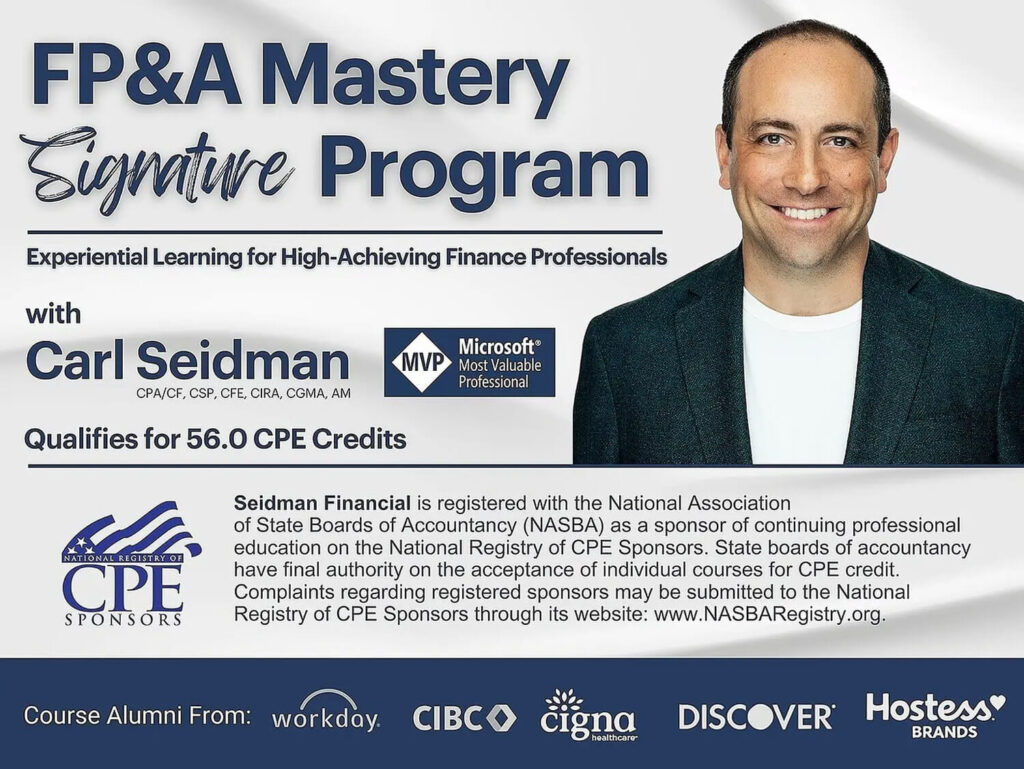
Seidman Financial is registered with the National Association of State Boards of Accountancy (NASBA) as a sponsor of continuing professional education on the National Registry of CPE Sponsors. State boards of accountancy have final authority on the acceptance of individual courses for CPE credit. Complaints regarding registered sponsors may be submitted to the National Registry of CPE Sponsors through its website: www.NASBARegistry.org.
Seidman Financial is a division of Seidman Global LLC.
2025 COHORT STRUCTURE:
- Track B: Tuesdays and Fridays, 1pm - 3pm CDT
- Weekly time commitment: 4.0 hours
- Total Live Commitment: 56.0 hours
- Total CPE: 56.0 credits
Who Is This Course For
Finance Directors and Managers responsible for team oversight, financially-driven decisions, and higher-level data-driven analysis.
Management consultants, FP&A advisors, and Fractional CFOs who offer business consulting services to small and midsized businesses.
Entrepreneurs planning to start a business and seeking foundational knowledge in financial management to ensure their venture is successful.
CFOs and financial analysts for SMBs who are tasked with data analysis, financial forecasting, and advising on financial matters.
Finance educators and professors who are looking to incorporate more experiential learning and business cases into their student journey.
What you’ll get out of this immersive financial learning & development experience, unlike any other you'll encounter:
-
Grow with a group of our peers and live learning + accountability that doesn't require you to teach yourself
Weekly live workshops that give you the dedicated space and accountability to learn, work on yourself, connect with other smart people, and develop your financial acumen. -
Tools, templates, models, and reports that you can implement right away
Get strategies, tools, templates, models, and systems that top FP&A teams use in their businesses. -
Apply what you learn to your work through business cases and practitioner-focused exercises
Exclusive capstone cases challenge you to apply what you learned. You'll receive personalized coaching from Carl and feedback others in the professional network. -
Develop a portfolio of your work that you can leverage in your current job or present to hiring managers if you’re seeking a new one
How do you land new opportunities at work if you don’t have the relevant experience? By getting relevant experience. Business cases will challenge you to push yourself into new domains. You’ll develop your own portfolio that you can take back to work or into new roles. -
Access to a network and community of top finance professionals you won't find anywhere else
Connection and collaboration opportunities with a global community of elite finance practitioners. -
Learn financial and business modeling, Excel, and financial analysis from a Microsoft MVP
Save time, minimize your rework, and eliminate your mistakes. Be spotlighted by your Directors, landing you better opportunities and the promotions you deserve. Learn modeling and analysis techniques from the 1 of the 35 US-based Microsoft MVPs in Excel. -
Develop strategic financial planning capabilities.
Strategic financial planning goes beyond short-term budgets and forecasts. You'll learn how to align financial plans with business objectives, assess investment opportunities, and plan for long-term growth. -
Master cash flow forecasting and modeling
Cash flow is the lifeblood of any business. You'll discover how to analyze cash flow drivers, manage working capital, and implement strategies to optimize cash flow. -
Communicate deliverables for the benefit of your leadership
You will learn how to incorporate various aspects of finance -- including accounting, corporate finance, and investment analysis -- into your financial deliverables. This comprehensive approach will allow you to analyze and interpret financial data from multiple perspectives. -
An always-evolving professional development ecosystem
Supplementary programs, workshops, and coaching to put everyone around you — including your team — on the same page. -
Live support from the experts
1:1 accountability and guidance from Carl Seidman and peers that keep you on track and ensure you never have to go at it alone.
This Course Includes

Live sessions
Learn directly from Carl Seidman CPA | Microsoft MVP in a real-time, interactive format.

Access to recordings
Go back to course content and recordings whenever you need to.

Community of peers
Stay accountable and share insights with like-minded professionals.

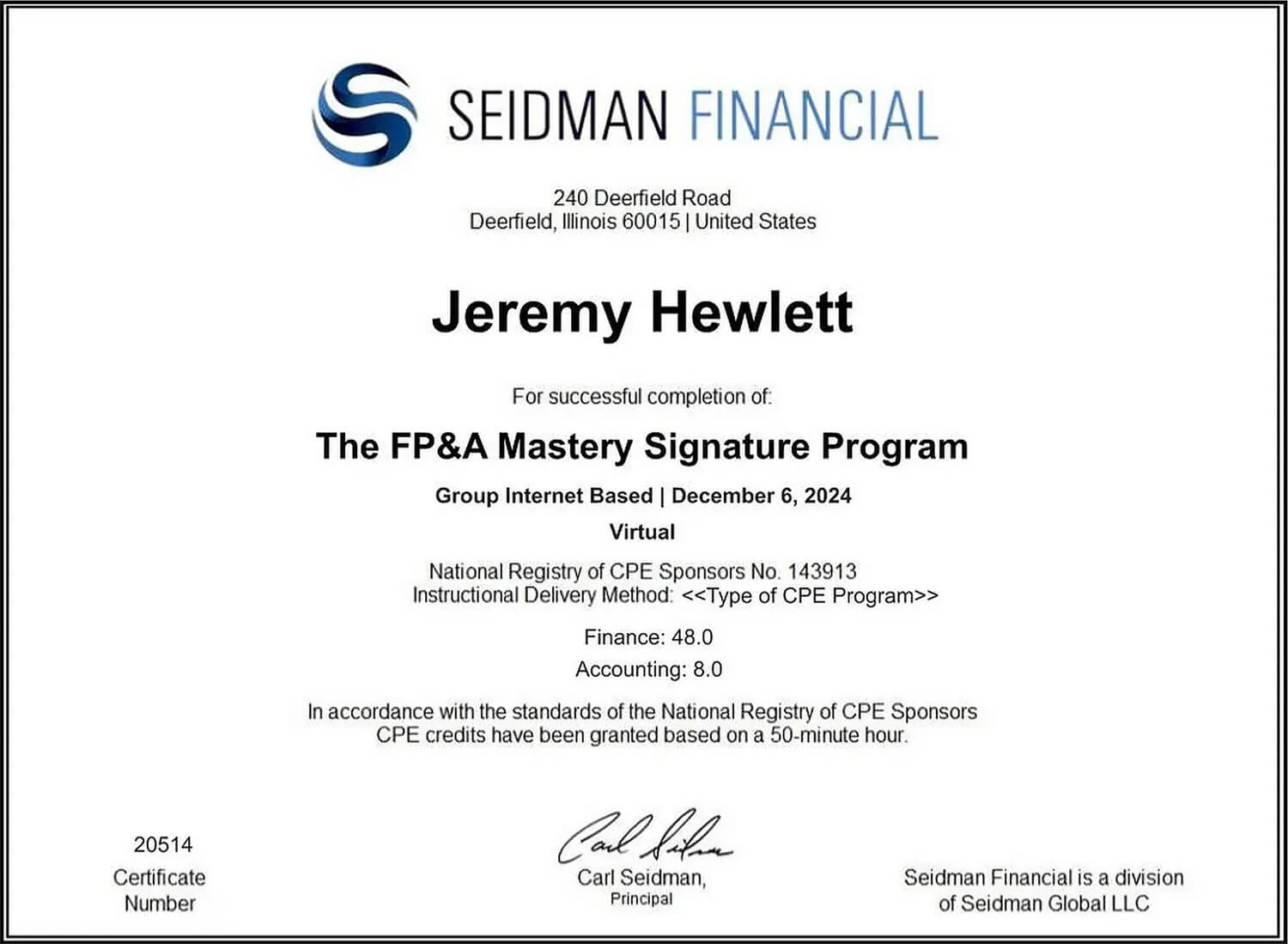
Certificate of completion and CPE credits
Share your new skills with your employer or on LinkedIn.
Not ready to join?
Add your name to the waitlist for the FP&A Mastery Signature Program to learn more about upcoming dates!
Course Syllabus
Week 1: Oct 21—Oct 26
✨ FP&A MSP - Budgeting + Rolling Forecasts: Live ✨
Tues. Oct 21 | 1pm CST
📄 Problems with traditional budgeting (rigidity, political sandbagging, time lag)
📄 Annual budgets versus rolling forecasts
📄 Changing business rhythms and why dynamic forecasting wins
📄 How FP&A can lead the planning shift without alienating leadership
✨ FP&A MSP - Budgeting + Rolling Forecasts: Live ✨
Fri. Oct 24 | 1pm CST
📄 Structuring assumptions in Excel for transparency and flexibility
📄 Identifying high-impact business drivers (volume, price, conversion, churn)
📄 Linking assumptions to revenue and expense line items
📄 Building budgeting and forecasts for the enablement of scenario analysis
Week 2: Oct 27—Nov 2
✨ FP&A MSP - Budgeting + Rolling Forecasts: Live ✨
Tues. Oct 28 | 1pm CST
📄 How sales and gross profit impact decisions about SG&A
📄 Budgeting and forecasting overhead expenses
✨ FP&A MSP - Budgeting + Rolling Forecasts: Live ✨
Fri. Oct 31 | 1pm CST
📄 Why forecasts break down: lack of ownership and engagement
📄 Structuring cross-functional forecasting conversations
📄 Making models understandable and relatable to non-finance teams
📄 Collaborative planning tools and tips (without needing expensive software)
Week 3: Nov 3—Nov 9
✨ FP&A MSP - Budgeting + Rolling Forecasts: Live ✨
Tues. Nov 4 | 1pm CST
📄 Disaggregate SG&A into actionable components
📄 Distinguish between fixed, variable, and step-function costs
📄 Use driver-based techniques where possible
📄 Incorporate controllability and accountability
✨ FP&A MSP - Budgeting + Rolling Forecasts: Live ✨
Fri. Nov 7 | 1pm CST
📄 How to set the forecast horizon (3-month, 6-month, 12-month, hybrid)
📄 Design choices: overwrite vs. layer on vs. rebuild
📄 Inputs and workflows: who provides what, and when
📄 Handling “actuals + forecast” views and continuous reforecasting
Week 4: Nov 10—Nov 16
📄 Break for Capstone Business Case Completion
Week 5: Nov 17—Nov 23
✨ FP&A MSP - Financial Analysis and Ops Mgt: Live ✨
Tues. Nov 18 | 1pm CST
📄 Overview of the income statement, balance sheet, and cash flow story
📄 Identify financial signals in growth, margin, working capital, and CapEx
📄 Where is the business succeeding and where is it failing?
✨ FP&A MSP - Financial Analysis and Ops Mgt: Live ✨
Fri. Nov 21 | 1pm CST
📄 Analyzing sales by channel, customer, SKU, and other criterion
📄 Model capacity, throughput, and utilization across production lines
📄 Structure COGS assumptions and analyze potential issues
📄 Bridge operations with financial outcomes using Excel-linked drivers
Week 6: Nov 24—Nov 30
Holiday Break (Thanksgiving) - No live sessions
Week 7: Dec 1—Dec 7
✨ FP&A MSP - Financial Analysis and Ops Mgt: Live ✨
Tues. Dec 2 | 1pm CST
📄 Defining the purpose of FP&A in business partnering
📄 Linking strategy > KPIs > metrics > decision making
📄 Building summaries and dashboards for financial and non-financial performance
✨ FP&A MSP - Financial Analysis and Ops Mgt: Live ✨
Fri. Dec 5 | 1pm CST
📄 How to select the right KPIs and objectives for business functions
📄 Financial vs. leading operational indicators (lagging vs. forward-looking)
📄 Techniques to track and update data and operating performance
Week 8: Dec 8—Dec 14
✨ FP&A MSP - Financial Analysis and Ops Mgt: Live ✨
Tues. Dec 9 | 1pm CST
📄 Structuring variance reports that tell the story
📄 Techniques for drilling down into sales, marketing ROI, hiring plans, etc.
📄 Communicating insights and recommendations to non-financial business partners
✨ FP&A MSP - Financial Analysis and Ops Mgt: Live ✨
Thurs. Dec 11 | 1pm CST
📄 Synthesize the model into 3–5 high-impact recommendations
📄 Structure analysis for presentation to ops or executive teams
📄 Distill complexity into clear visuals and decision points
📄 Move from reactive finance to forward-operating business partner
Week 9: Dec 15—Dec 21
📄 Break for Capstone Business Case Completion
Week 10: Dec 22—Dec 28
Holiday Break - No live sessions
Week 11: Dec 29—Jan 4
Holiday Break - No live sessions
Week 12: Jan 5—Jan 11
Holiday Break - No live sessions
Week 13: Jan 12—Jan 18
✨ FP&A MSP - Advanced Cash Flow Modeling: Live ✨
Tues. Jan 13 | 1pm CST
- Aging Analysis Techniques: Learn how to perform detailed aging analysis to categorize receivables by their due dates, which helps in identifying trends in customer payments and prioritizing collection efforts. Set up aging buckets and interpret the implications of aging trends on overall cash flow.
- Rollforward Reports Creation: Gain proficiency in constructing rollforward reports for accounts receivable, which track changes from the beginning balance to the ending balance over a specific period.
📄 The accounts receivable accounting equation
📄 Analyzing the accounts receivable aging report
📄 Analyzing historical trends, terms, and anticipated receipts
📄 Data automation and rolling the receivables forecast
✨ FP&A MSP - Advanced Cash Flow Modeling: Live ✨
Fri. Jan 16 | 1pm CST
- Detailed Payroll Cost Analysis: Learn to conduct an in-depth analysis of payroll costs, breaking down expenses by types such as salaries, wages, bonuses, and benefits. This module will teach techniques for understanding the implications of each component on overall cash flow and forecasting future payroll liabilities.
- Forecasting Payroll Expenses: Develop skills to forecast payroll expenses accurately, considering factors such as seasonal hiring, contractual raises, and policy changes.
📄 Analyzing payroll schedules
📄 Analyzing the impact of different payroll cycles
📄 Contemplating raises and COLA adjustments
📄 Restructuring compensation
📄 Analyzing layoffs, severance, and related contingencies
📄 Integrating payroll into comprehensive cash flow models
Week 14: Jan 19—Jan 25
✨ FP&A MSP - Advanced Cash Flow Modeling: Live ✨
Tues. Jan 20 | 1pm CST
- Optimal Payment Timing Strategies: Learn to strategically time payments to manage cash outflows effectively, balancing early payment discounts against cash retention priorities. This includes techniques for assessing the financial benefits of various payment terms and optimizing cash flow through payment scheduling.
- Accounts Payable Aging Analysis: Develop skills in conducting a detailed aging analysis of accounts payable to identify payment patterns and prioritize payments.
📄 The accounts payable accounting equation
📄 Analyzing the accounts payable aging report
📄 Analyzing terms, critical relationships, and payment strategies
📄 Contemplating early-pay discounts and tradeoffs
📄 Contemplating early-pay discounts and tradeoffs
✨ FP&A MSP - Advanced Cash Flow Modeling: Live ✨
Fri. Jan 23 | 1pm CST
- Developing a Roll-Forward Process: Establish a recurring process and low-code experience for incorporating new data into the financial model.
- Utilize Power Query and Raw Data to Populate the Model: Connect the weekly cash flow model to supporting schedules through the use of Power Query.
- Learn the basics of data cleaning and reformatting: Familiarize yourself with Power Query’s transformation tools to build smarter data sets that can be easily mapped into the cash flow model.
📄 Updating the Cash Flow Model for New Data
📄 Connecting Back-End Financial Data into the Cash Flow Model
📄 Overview of Data Mapping
📄 Introduction to Microsoft Power Query
Week 15: Jan 26—Feb 1
✨ FP&A MSP - Advanced Cash Flow Modeling: Live ✨
Tues. Jan 27 | 1pm CST
- Compare and contrast near-term cash flow forecasting with long-term needs: Examine long-term planning assumptions and bridge the weekly cash flow model to the longer-term operating and financial model.
📄 How a Long-Term Planning Model Differs from a Near-Term Cash Flow Model
📄 Excel Functionality for Seamless Integration Between Weekly and Monthly Forecast
📄 Connecting the Weekly Forecast to the Monthly Forecast
✨ FP&A MSP - Advanced Cash Flow Modeling: Live ✨
Fri. Jan 30 | 1pm CST
- Capex Planning and Budgeting: Learn the principles of strategic CapEx planning and budgeting, focusing on aligning investments with long-term business goals. This includes methods for evaluating the potential returns on investment (ROI), assessing risk, and prioritizing capital projects based on strategic objectives.
Scenario Analysis for Capex Decisions: Gain expertise in conducting scenario analyses to explore different capex strategies and their potential financial outcomes.
📄 Analyzing historical maintenance capex
📄 Planning for investment capex and major projects
📄 Scenario analysis for capex decisions and contingency planning
Week 16: Feb 2—Feb 8
✨ FP&A MSP - Advanced Cash Flow Modeling: Live ✨
Tues. Feb 3 | 1pm CST
- Understanding Debt Structures and Terms: Analyze various debt structures and their terms, including fixed vs. variable interest rates, maturity periods, and amortization schedules.
- Scenario Analysis for Debt Management: Performing scenario analysis to assess the impact of different financial and economic conditions on financing and debt service requirements.
📄 Credit agreements and terms
📄 Integrating financing and amortization schedules
📄 Automating debt service
✨ FP&A MSP - Advanced Cash Flow Modeling: Live ✨
Fri. Feb 6 | 1pm CST
- Comprehensive Scenario Modeling: Build robust scenario management functionality allowing the model to contemplate multiple scenarios with ease.
- Advanced Concepts in Cash Flow Forecasting: Consider more nuanced topics including consolidation across multiple business units, bankruptcy, and fundraising.
📄 Comprehensive scenario management
📄 Advanced concepts in cash flow forecasting and liquidity management
Week 17: Feb 9—Feb 15
✨ FP&A MSP - Advanced Cash Flow Modeling: Live ✨
Tues. Feb 10 | 1pm CST
- Forecast-to-actual variances: Update the cash flow forecast for actuals and compare it to expectations, assessing favorable and unfavorable variances and rolling it forward for new assumptions.
- Forecast version to forecast version variances: Evaluate current weekly cash flow forecasts against prior versions, discovering what has changed, why, and to what extent.
📄 Forecast-to-actual variances
📄 Forecast version to forecast version variances
📄 Interpreting variances and rolling the forecast
✨ FP&A MSP - Advanced Cash Flow Modeling: Live ✨
Fri. Feb 13 | 1pm CST
Items coming soon.
Week 18: Feb 16—Feb 22
✨ Optional Office Hours ✨
Week 19: Feb 23—Mar 1
📄 Break for Capstone Business Case Completion
Week 20: Mar 2—Mar 8
✨ FP&A MSP - Fin. Presentations + Exec Presence: Live ✨
Tues. Mar 3 | 1pm CST
• Introduction to the program
• Survey responses to how FP&As spend their time
• Why many financial and data-rich presentations fail
📄 The misguided focus of finance professionals
📄 Human intelligence versus artificial intelligence
📄 What does effective communication in finance look like
📄 Effective vs. ineffective business communication
📄 Why financial presentations fall flat
✨ FP&A MSP - Fin. Presentations + Exec Presence: Live ✨
Fri. Mar 6 | 1pm CST
• Tailoring approaches to financial topics
• Balancing technical jargon for clarity and impact
• Identifying the needs and knowledge level of the audience
• Incorporating audience objectives and feedback to refine the approach
📄 The flow of business communication
📄 Identifying the mandate and needs of the audience
📄 Gap analysis and bridging the gap
📄 Financial presentations begin before the presentation
📄 Evaluating Communication Styles
📄 Managing the message and the presentation
Week 21: Mar 9—Mar 15
✨ FP&A MSP - Fin. Presentations + Exec Presence: Live ✨
Tues. Mar 10 | 1pm CST
• Simplifying financial terms for broader understanding
• Incorporating strategies to maintain audience interest and attention
• Pre-planning to address audience concerns and viewpoints
• Using different discussion formats to connect with the audience
📄 Building rapport and credibility with financial and non-financial audiences
📄 Leveraging information flow and delivery methods to establish credibility
📄 Flow and intentional engagement of limited cognitive attention
📄 Simplicity, clarity and assessing what’s in it for them
✨ FP&A MSP - Fin. Presentations + Exec Presence: Live ✨
Fri. Mar 13 | 1pm CST
• Choosing the most relevant and impactful data and insights for your narrative
• Building a coherent information flow from introduction to conclusion
• Emphasizing main points through clear data presentation
• Helping your audience understand implications of the data
📄 Managing the message and the presentation
📄 Visual overload, lack of clarity and purpose
📄 Managing time, conflicting agendas, and focal points
• Selecting the right visuals for data
• Ensuring clarity and readability in data visualization
• Techniques for impactful data presentation
• Balancing visuals with narrative
📄 Informative versus emotive visuals
📄 What makes visual displays confusing
📄 Dishonest and deceptive presentations
📄 Preparing support schedules and backup
Week 22: Mar 16—Mar 22
✨ FP&A MSP - Fin. Presentations + Exec Presence: Live ✨
Tues. Mar 17 | 1pm CST
• Establishing yourself as the credible authority in the room
• Maintaining control and respect in all interactions
• Addressing limitations and uncertainties in data
• Ensuring all information and statements are accurate and up-to-date
📄 Credibility versus relevance
📄 Connecting with financial and non-financial audiences through relevance
📄 6 elements of trust and rapport
✨ FP&A MSP - Fin. Presentations + Exec Presence: Live ✨
Fri, Mar 20 | 1pm CST
📄 Characteristics of a strong PowerPoint presentation
📄 Visual consumption and cognitive synthesis
📄 Balancing visual with verbal deliveries
📄 Multitasking and audience distraction
📄 Memory retention
Week 23: Mar 23—Mar 29
Holiday Break - No live sessions
Week 24: Mar 30—Apr 5
✨ FP&A MSP - Fin. Presentations + Exec Presence: Live ✨
Tues. Mar 31 | 1pm CST
• Tailoring presentations for in-person vs. virtual settings
• Utilizing online platforms and the room effectively
• Managing technical aspects like audio-visuals and connectivity
• Timing the delivery for maximum impact and retention
📄 Differences between in-person and virtual presentations
📄 Effective room management for in-person and virtual settings
📄 Common mistakes in virtual meetings and presentations
• Strategies for maintaining composure and authority
• Adapting to unexpected questions or changes
• Quick problem-solving during presentation disruptions
• Techniques for managing disruptive behavior tactfully
📄 Managing audience personalities and politics
✨ FP&A MSP - Fin. Presentations + Exec Presence: Live ✨
Fri. Apr 3 | 1pm CST
• Crafting a compelling story around financial data
• Making complex financial data relatable through intentional dialogue
• Breaking down intricate financial concepts
• Using business storytelling techniques to evoke interest and connection
📄 Data, statistics and storytelling
📄 Providing insights and providing the message
📄 Determining how much or little information to provide
📄 Presenting reports versus delivering presentations
Week 25: Apr 6—Apr 12
✨ Optional Office Hours ✨
Week 26: Apr 13—Apr 17
✍️ Capstone Business Case
"Carl is an excellent coach. He focuses on the practical aspect of the day-to-day challenges vs. only focusing on theory. I absolutely enjoyed this course and learnt a lot. Highly recommended."
-- Preet, Finance Director (Visa)
Meet Carl, Your Instructor and Guide
Carl Seidman CPA | Microsoft MVP
Principal, Seidman Financial
Carl is a go-to FP&A development facilitator for Fortune 500s, mid-market companies, and entrepreneurial businesses. He is a Microsoft MVP (1 of just 35 US-based Excel MVPs) and one of the preeminent trainers and facilitators in strategic finance and FP&A, with more than 13,000 participants attending his financial training programs, seminars, workshops, and masterminds. Notable clients include:
ABM Industries, Accordion, AlixPartners, Allscripts, Broadridge, CHEP, Choice Hotels, CIBC, Cigna, Cox Enterprises, Crawford & Company, Deloitte, Dexcom, Discover, Dominium, Express Scripts, EY, FS Investments, EVRAZ, Genentech, Healthpeak, Heartland Financial, Hewlett Packard Enterprise, Hostess, IGT, KPMG, Marsh & McLennan, Michelin, NerdWallet, Radisson, Rapid7, Sol Petroleum, Spotify, Triple-S, Telus, Santander, United Technologies (RTX), UBT, Verizon, Walmart, and Workday.
Carl is masterful at making the complex amazingly simple, engaging his audiences, building confidence, and facilitating a welcoming and transformative group experience. His content is rich and relatable, used in financial leadership development programs (FLDPs) at Fortune 500 companies, and is utilized or licensed by 7 of the top global financial training companies.
Carl serves as an Adjunct Professor in data analytics at the Jones School of Business at Rice University. He is a Certified Public Accountant (CPA) has earned other professional credentials including the CIRA, CFF, CFE, CGMA, AM (Accredited Member in Business Valuation), CSP (Certified Speaking Professional), Certified Anaplan Model Builder, and was a National Association of Certified Valuators and Analysts (NACVA) 40 Under Forty honoree. He holds a BA in finance and economics and an MS in managerial accounting.
He’s been where you want to be and does the work you want to do.
Contact: info@seidmanfinancial.com
"Carl is an excellent teacher and really cares about his students...he stayed after hours with me to talk me through how to apply to my specific model and was incredibly helpful...I'm almost done a week following the course with my new forecasting model."
-- Sarah, FP&A Sr. Mgr.
Course Schedule
- 4 hours per week, 2x sessions per week
Tuesdays & Fridays
1:00 - 3:00pm CST (2 hours, 2x/week)
All sessions take place live. All sessions are recorded for future access, whether you miss a session or wish to revisit certain topics and discussions.
Because the FP&A Mastery Signature Program has a rolling curriculum, you may access recordings of prior live sessions.
On-Demand Sessions
Missed a session? No problem!
Every live session is recorded so you can access it after it takes place.
Want to access to a live session and group discussion before it runs again? Get on-demand access to prior live cohort sessions any time you want.
Everything is at your fingertips.
Capstone Projects
At the conclusion of each core course
Capstone projects are unveiled at the end of each course, at the conclusion of the final session. Attendees may attend office hours and are given 1 week to complete the project. Upon submission, attendees will receive coaching and feedback.
Office Hours
At the conclusion of each core course
Guest Sessions
Finance experts and software vendors
"This was my first course on business models, and Carl's course is very detailed and comprehensive. Carl is a great coach and makes financial modeling more accessible."
-- Sandrine, Senior Controller (Instabug, Inc.)
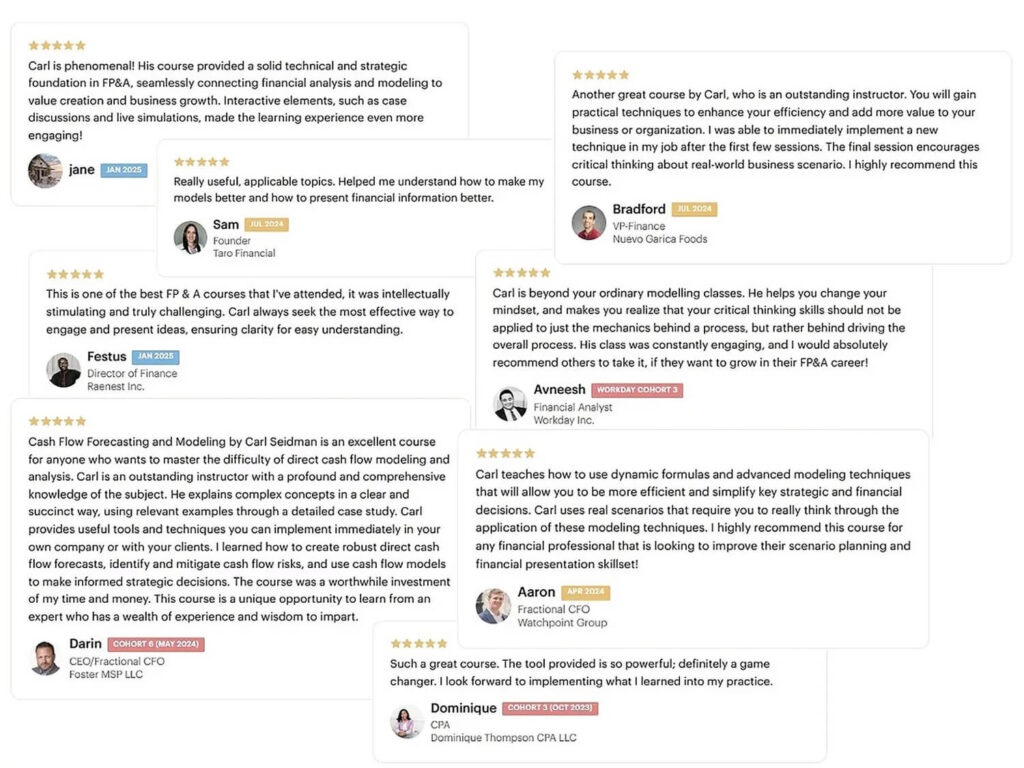
500+ FP&As have improved their technical and non-technical skills with Carl's cohort-based Maven courses. Here's what they have to say:
Join an upcoming cohort
FP&A Mastery Signature Program
COST
$3,500
UPCOMING
MSP TBC1 (Oct 2025)
DATES
Oct 21—Apr 17, 2026
PAYMENT DEADLINE
Oct 21, 2025
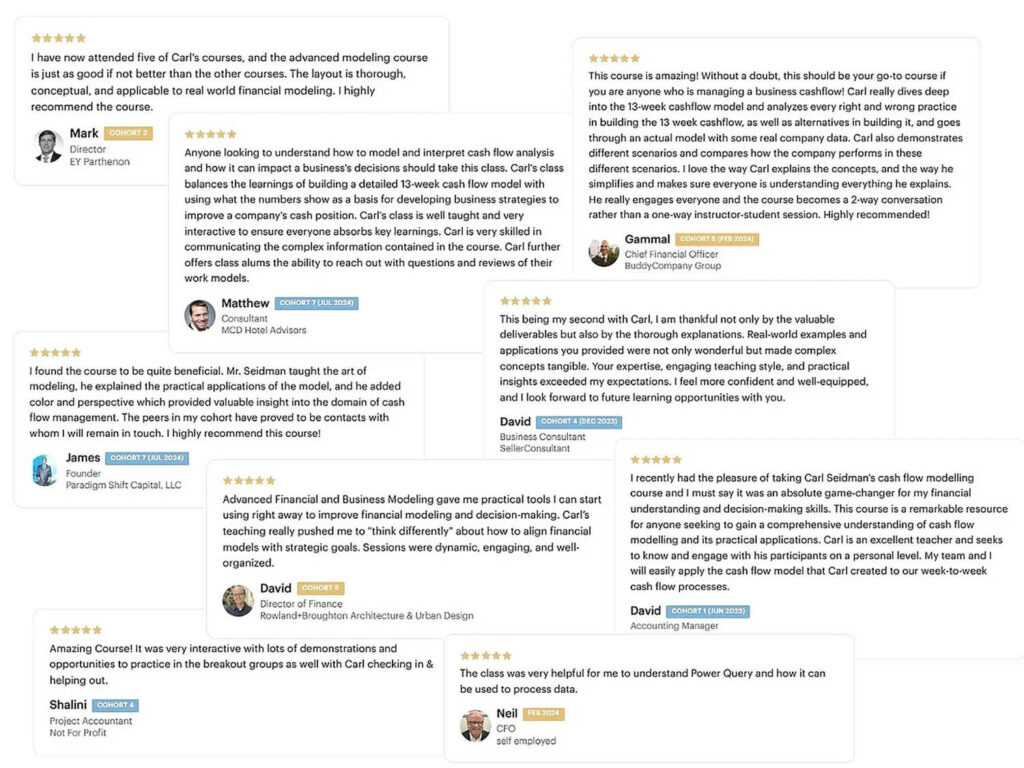
Here's what attendees of these courses have to say about the learning experience:
"Very interactive, and this helps reinforce key concepts. The course takes your thinking to a higher level as it creates the awareness of organizing the information in a logical and thoughtful way so that making future changes are easy."
-- Marian, Treasury Accountant (SLES Ltd)
Growth is so much better with live
cohorts and experiential learning
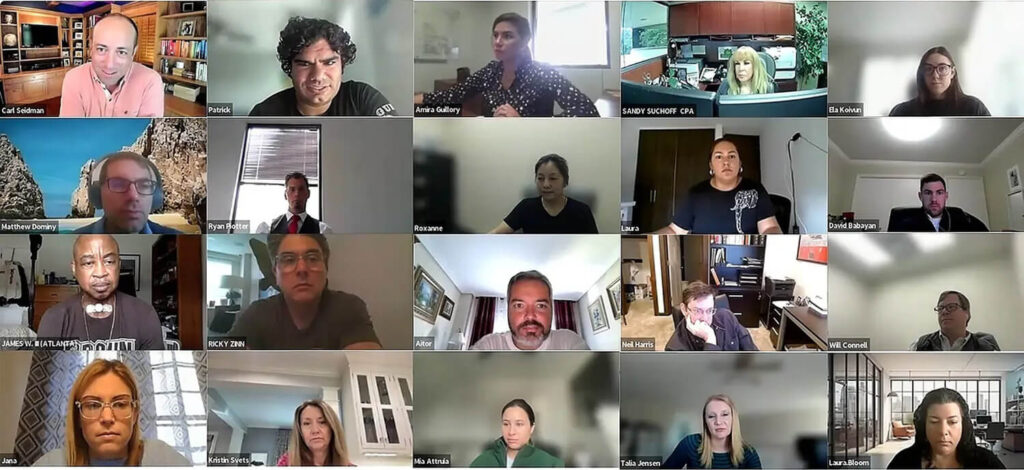
Active hands-on learning
This course builds on live workshops and hands-on projects
Interactive and project-based
You’ll be interacting with other learners through breakout rooms and project teams
Learn with a cohort of peers
Join a community of like-minded people who want to learn and grow alongside you
A one-of-a-kind experiential learning ecosystem, eligible for up to 56.0 CPE credits
Receive a certificate of completion to share with your network and coworkers
A pattern of wavy dots
"Overall a great course for professionals looking for a refresher on modeling as well as more experienced FP&A Managers. The pace was great and Carl always made time for interaction and Q&A throughout the course."
-- Jeff, Director of FP&A and Operations Finance (Eos Energy)
Frequently Asked Questions
No problem. While you are encouraged to attend live sessions — as a great part of the experience is both the live-reveals and the participant interaction — all sessions are recorded and may be accessed on your own time.
The experience is intentionally spaced out — 2 days each week over many weeks — so you can work your schedule around it.
There may be occasional pre-work and post-session work but it is minimal.
Because all sessions are recorded, you can revisit topics and discussions on your own schedule.
It is not customary for us to receive requests for refunds. However, if you are dissatisfied with your experience, please reach out to our customer service team so we can ensure you receive the value you expect.
I offer more than a dozen training programs and immersive development experiences across a wide range of finance and accounting topics.
Here are the other programs I offer.
This program is designed for finance professionals who want the most comprehensive, connected experience, community, and results.
We meet live on Zoom for 2 hours, 2x per week.
Each session consists of 1-2 learning topics and modules. Each module ties into prior and future modules, so it is important to try to avoid missing classes or watched recordings.
The structure of the session begins with an intro, a tie-in to a real example, exercises, discussion, and reflections.
Prerequisites for the course include the following:
- You should have a basic-to-intermediate understanding of Microsoft Excel
- You should have a current version (2016 or later) of Microsoft Excel, ideally (though not necessary) on a PC.
- You should have at least an basic understanding of accounting and finance concepts.
No, but I will offer you my promises.
Everyone who attends this experience will have different backgrounds and aspirations which means they have different business models or jobs.
My promise is to share with you my techniques, tools, and processes that will accelerate your finance career and make you far more confident in what you do
Yes. You get all of the template models, clean and completed.
Yes, it qualifies for 56.0 CPE credits.
Seidman Financial is registered with the National Association of State Boards of Accountancy (NASBA) as a sponsor of continuing professional education on the National Registry of CPE Sponsors. State boards of accountancy have final authority on the acceptance of individual courses for CPE credit.
Most on-demand courses teach steps for plugging numbers into basic models. They don’t teach the nuances that you’re likely to encounter across a wide range of instances. And most course trainers don’t come from FP&A and CFO backgrounds.
According to alumni, this is the best FP&A course curriculum available.
While students can enroll in any course individually, the FP&A Mastery Signature Program is designed as the most comprehensive, high-value, learning experience in the FP&A space.
Students are encouraged to get the most complete experience versus enrolling in each course one at a time.