How to see what’s actually happening inside a business when nobody’s asking the right questions – Part 1
Part 1: The Numbers Everyone Ignored
I arrived at Hartwell Toys.*
* Company name has been changed.
On day one, the founder’s son (and part owner) Daniel walked me through the warehouse proudly. Shelves were packed floor to ceiling with toys. You’d assume the company was thriving.
What struck me as odd though was that as many different SKUs as the company had, each shelf space had just a few units. In other words, there was massive diversification of SKUs, but not a lot of stock in each. In some cases, there was just one.
I walked over to the office, across the street from the warehouse, and saw on the board room table a 200+ page beautifully designed,printed catalog packed with toys across every conceivable category: classic games, arts and crafts, plush animals, educational toys, action figures, remote control vehicles, infant and toddler toys, and more.
“We carry everything,” Daniel told me.
If you looked at the warehouse and glanced at the catalog, you might think this company was doing $100 million+ in revenue. But they weren’t. They were doing less than $10 million.
Daniel explained that the breadth of Hartwell’s catalog basically grew by accident. Whenever a customer requested a new SKU, Hartwell would source it, add it to the catalog, and hope other customers would eventually pick it up. Most didn’t.
And once a product stopped selling, there was no clean exit — dropping it meant expensive catalog reprints; keeping it meant either scrambling to fulfill rare one-off orders or repeatedly apologizing for stockouts.
Trust, But Verify
Just like the brimming shelves seemed to indicate success, the financials seemed to indicate stability.
My review of the financial statements and sales reports showed that revenue was stable. It certainly wasn’t growing, nor was it in decline. It was just a regular, mature business, with revenue oscillating up or down by 5%-15% year over year. Everyone seemed calm. Nothing to worry about.
But there was plenty to worry about. Let me explain.
For over 20 years, I’ve worked with companies at every stage — from rapid growth to stagnation to outright distress. I’m blessed – and cursed – with what I believe is a healthy sense of skepticism. It started in litigation consulting, where my first bosses drilled into me: “Trust, but verify.”
It’s not that most people are dishonest — but quite a few are self-deceived. People don’t lie to me but they repeat what they’ve convinced themselves is true. And a comfortable half-truth, believed sincerely, can be very hard to fix.
Other Metrics Matter More
Despite full shelves and stable revenue, the rest of Hartwell’s finances told a very different story. Margins were compressing and net profit margin was sub 3%. Nobody could actually tell me which products actually make money. Forget SKU profitability. They didn’t even know which toy categories were their best performers.
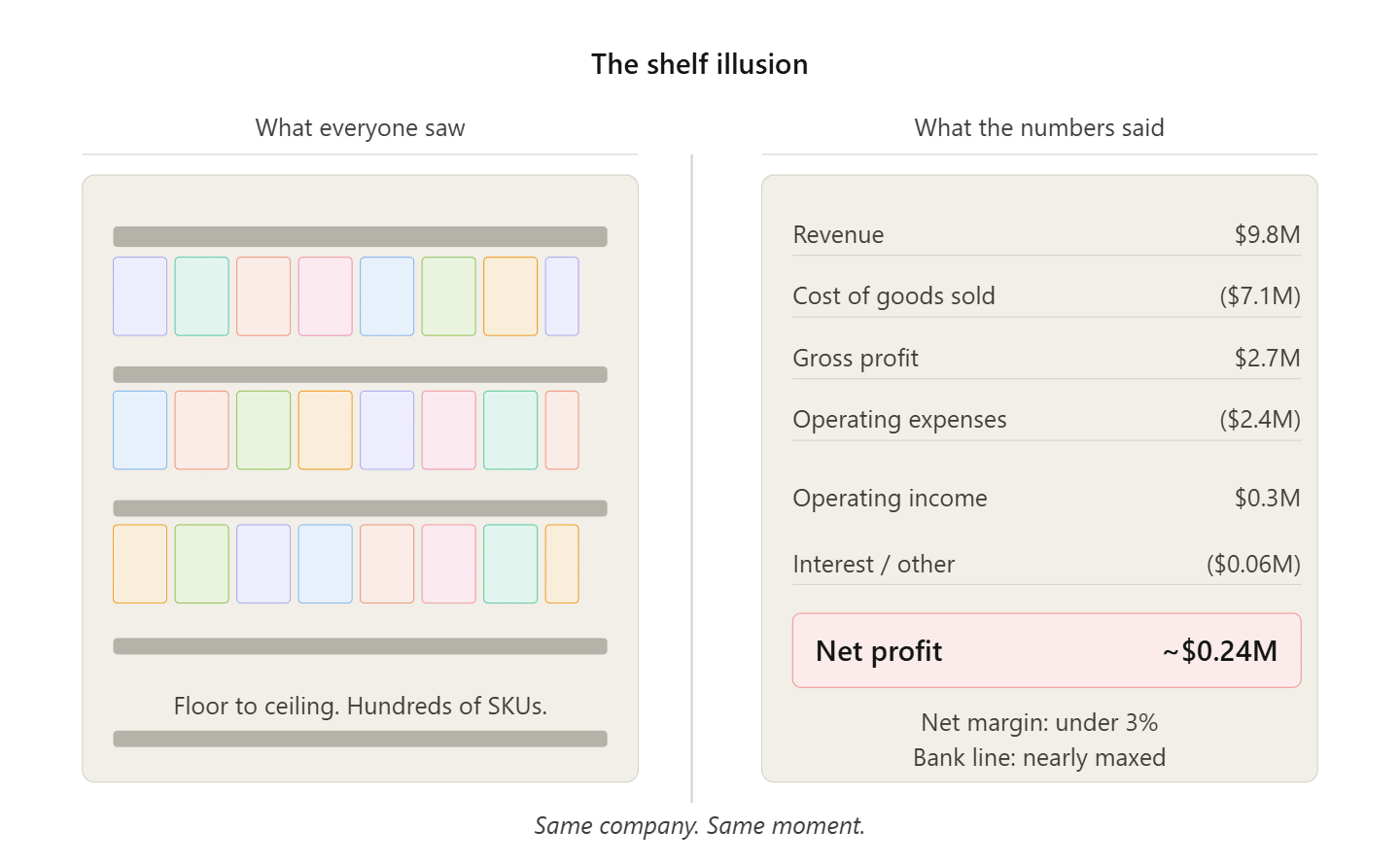
Like so many companies I’ve encountered, business felt busy but fragile. Sales were happening, but most people outside of accounting had no idea how precarious things were.
In my discussions with Daniel’s father – Aaron, the founder and majority owner – he admitted that the bank line was nearly maxed. The facility was aging, and a major capital decision about renovation or relocation was looming. He said Daniel knew, but believed they could grow their way out of it.
Some Companies Are Just Like the Others
You might be thinking: “How could a company get to $10 million without understanding their numbers?”
I used to think that too, especially right out of grad school, when I figured most businesses following textbook guidance. But that’s hardly ever the case, and I learned that early on. And as I worked with more companies, it actually seemed that hardly any followed textbook rules. Some businesses reach 7- or 8-figures through brute force: hard work, good products, and good timing. They move fast, respond to demand, and keep going. What was so striking about Hartwell was that it was so similar to at least three other clients I’d worked with: a CPG company in health and wellness, an equipment and workwear distributor, and an industrial products manufacturer. All great companies. All driven by entrepreneurial instincts that pulled them toward every customer request. But here’s what I’ve rarely seen: a company that genuinely sells its way out of serious operational dysfunction. Usually, it just becomes a bigger company with major operational dysfunction.
What We Did: It Started with Cash Flow
I engaged with Hartwell for close to a year, paused, then eventually came back a second time. While sales was the surface problem, working capital was the bigger issue.
Cash was literally sitting on the shelves. New stock kept being added through one-off orders, incentivized by sales commission structures. The finance team had no cash flow forecast beyond a couple of weeks out. There was no visibility into whether the bank line could be serviced, or what was coming.
It wasn’t quite a crisis. But it felt like we were months from the edge of a cliff.
Our first move was building a weekly-to-monthly cash flow model. That gave us enough visibility to manage the current situation and plan a soft landing as the product catalog got rationalized.
Product Rationalization Was the Key
I’ll admit (and you could probably guess) that I’m not a toy expert. Walking in and telling a toy reseller what to cut would be reckless. What FP&A advisors bring — in the absence of domain expertise — is the ability to gather and analyze data, present it to the people who actually know the business, and then work together toward a turnaround strategy.
Here’s what the analysis revealed:
- Stable revenue can be dangerous. Even though revenue was basically flat, and not raising major concerns, it was the changing margins and mix that were most problematic. The new sales orders masked the reality that the company was barely making any money. And with the line of credit maxed, and a heavy facility-related capex decision forthcoming, compressed margins were a problem.
- The customer portfolio was sprawling. What the sales data revealed was that Hartwell was selling a massive array (not necessarily a massive volume) of toys to a huge number of customers. The average sales per customer was only in the low tens of thousands. For a $10 million reseller, that meant hundreds of small accounts.
- The product portfolio lacked a clear strategy. The sales data showed that the product catalog was so diversified that it wasn’t immediately clear where the growth / nurture / terminate decisions should be. There was no contribution margin analysis by category, no velocity or inventory turn data. It was nearly impossible to conduct an analysis with the data in the form as it existed.
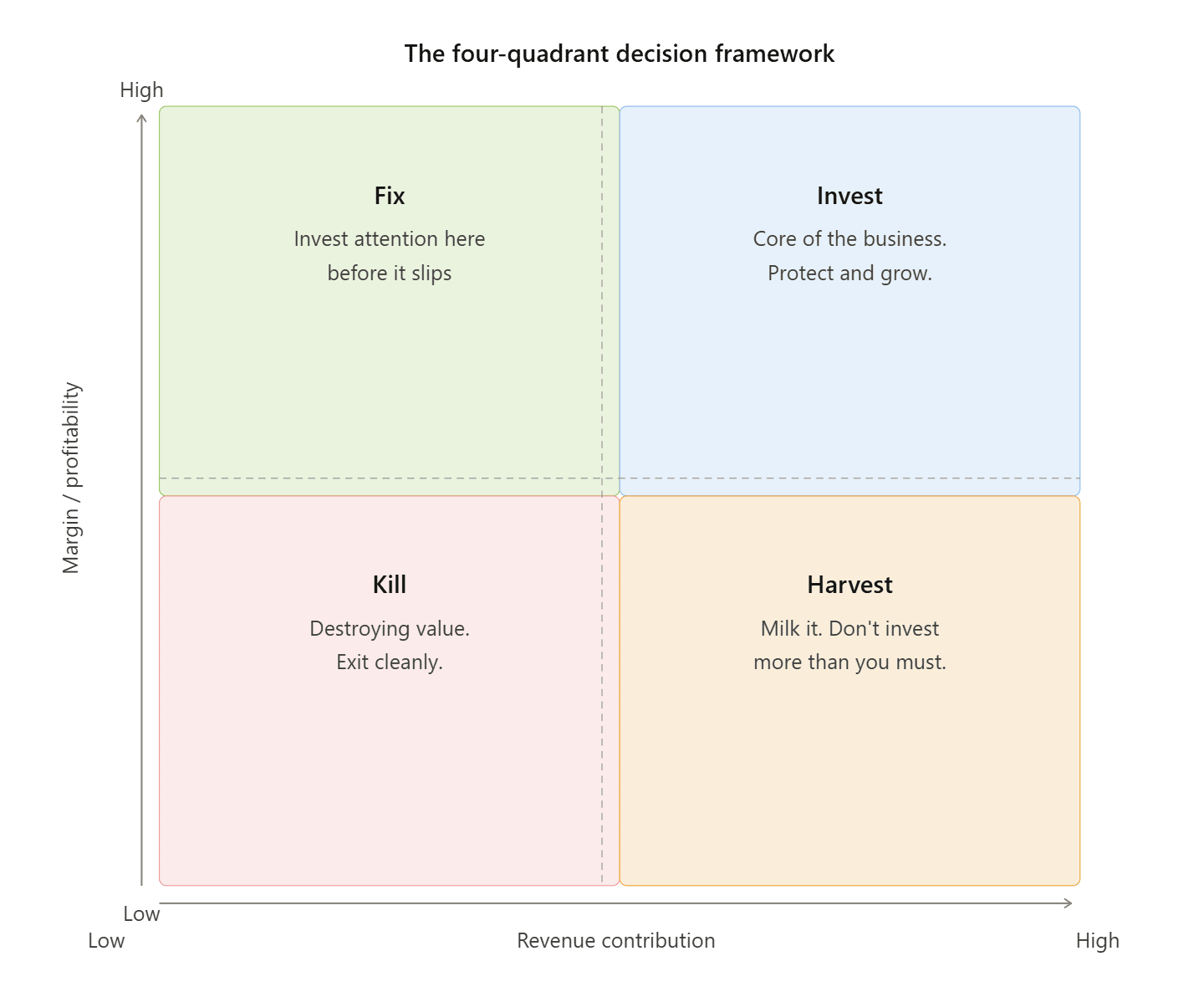
- The four-quadrant framework would give leadership a compass. Not my invention, but one of the most useful tools in these situations: placing each customer and product into one of four go-forward decisions — Invest, Harvest, Fix, or Kill. This analysis gave leadership a better understanding of where they were and weren’t performing. It provided logic and reason to decisions, rather than simply running to shifting client demands.
The Numbers Were Clear. The Emotions Were Not.
The data told a stark story: 40–50% of Hartwell’s SKUs were probably destroying value. Cutting them was the obvious call.
But knowing what to cut is the easy part. Actually cutting it is something else.
Salespeople who’d serviced the same accounts for years didn’t want to walk away. The team was attached to certain products (remember, we’re talking loveable toys) and couldn’t imagine dropping them. The inventory sitting on those shelves? Still felt like a good, sellable product even when it wasn’t moving.
There’s also the pull of sunk commitments: a printed catalog, a signed lease, and long-standing vendor relationships. These create invisible switching costs that distort rational decision-making. The analysis isn’t just financial. It’s behavioral. And that’s something I’ve come to learn more and more throughout my career. As I often say (…and credit to Mike, one of my former mentors for the phrase) “Half of our work is finance, half of our work is counseling.” Once you’ve done the math, it’s all about people.
Then there was the big-box retailer deal Daniel had been pursuing. It was a massive contract that would require financing a large purchase order from an Asian supplier with no full prepayment upfront. More complexity. More risk. All seduction by having a big name and numbers on their docket of customers and sales.
Knowing what to cut is largely data-driven. But the harder question is what comes next: What do you do with a warehouse full of inventory nobody wants, and a leadership team emotionally tied to the products that built the company?
How, as an outsider, do you assert a “say no” mentality, get buy-in and keep it?