29 Predictions: How AI May Make the Four-Year Finance Degree a Harder Sell
Predictions #4–6: The University Model Under Pressure
I teach data analytics at the graduate level and I genuinely love that work. So before I go further, let me be clear: I am not anti-college. I am anti-autopilot.
And the autopilot assumption — that a four-year degree is the default next step for almost every young person, regardless of what they want to do or learn — is one I believe is going to begin breaking down.
Disclaimer: The following views and opinions are my own and do not reflect the views or opinions of any professional organizations or enterprises I work/partner with.
Prediction #4: The Four-Year Degree Stops Being the Default Path
For most of the past fifty years, the calculus for white-collar professions was simple: go to college, pick a practical degree, get your diploma, get a good job, build a career. And because it worked reasonably well, it became more than a choice. It became the default assumption.
I believe that assumption will weaken dramatically over the next generation.
A decade ago, I saw the early signs of this and delivered a TEDx talk on the importance of portfolio careers and diversification across education and work. I called it “Why I Retired at 32” (credit to Adam Grant who suggested the title to me). What I described then, as an emerging possibility, is now becoming a genuine inflection point.
Similar to professional credentials like the CPA and CFA, the value of a degree has always rested on two foundations:
- the knowledge it provides, and
- the signal it sends to employers.
AI puts pressure on both.
As AI makes technical knowledge more accessible and increasingly performs portions of knowledge work itself, employers will place greater emphasis on demonstrated capabilities rather than educational pedigree alone. The main exception I see being elite universities, where reputation and brand will still possess significant signal.
At the same time, the skills that businesses need may evolve faster than traditional four-year curricula can adapt to.
When a credential no longer reliably predicts performance, and when the underlying skills landscape is changing faster than institutions can respond to, the default assumption is going to have to get re-examined.
I’m not saying higher education disappears. Absolutely not. But the unexamined assumption that college is the right move for everyone, at age 18, regardless of their goals, strengths, or interests, will continue to be challenged. The generation currently in high school is going to make genuinely different choices than their parents made. And their parents are going to have a harder time arguing against it.
With the exception of a small number of career paths, the best-positioned young professionals will be those who build for a lifetime of career agility. Because the markets they enter will be constantly disrupted and reinvented.
The right questions for a 17-year-old today may no longer be, “Where should I go to college?”
They may be:
- What problem do I want to solve?
- What skills does that actually require?
- What are my unique strengths?
- What combination of education, experience, and community gets me there most efficiently?
- What’s the most cost effective way to do that?
For some, the answer is still a four-year university. But for more of them than before, it may not be. And that distinction is going to matter enormously.
Prediction #5: The Economics of Higher Education Reach a Breaking Point
Tuition at four-year institutions has increased at roughly twice the rate of inflation for decades. Look at a list of where societal costs – education, healthcare, auto, electronics, food, etc – have grown the most, it’s higher-education. The numbers have been unsustainable.
Total student loan debt in the United States is now approaching $2 trillion. The average borrower isn’t a graduate student who went to law school. It’s often a young adult who borrowed tens of thousands of dollars for a degree whose economic return is far less certain than previous generations were led to believe.
For years, the rising cost of higher education was justified by a relatively straightforward assumption: a degree would reliably produce higher lifetime earnings.
AI threatens to weaken that assumption.
Not because degrees will become worthless, but because AI is changing the economics of knowledge, education, and work itself. Entry-level roles are going to evolve and career paths are becoming less linear. Technical skills are becoming easier to access outside traditional institutions. And employers are going to increasingly reconsider how they evaluate talent.
When the future value of a degree becomes harder to predict – not necessarily less valuable, more uncertain – the cost becomes harder to justify and the return needs to go up. It’s the same risk/reward balance of financial investments.
When I was a teenager, going to college wasn’t a question. The only questions were where and what to study. It worked out well for me. But had I graduated just a few years later, during the Great Recession, my trajectory could have looked very different.
The political conversation tends to focus on debt forgiveness. While considerate, I see that as a temporary Band-Aid on a much more chronic, long-term problem. The deeper issue is the value proposition of expensive higher education degrees. AI is going to accelerate scrutiny of that value proposition at exactly the moment when student debt burdens are already stretched.
Young people are going to do the math.
Not all of them, and not consistently, but enough of them that high-cost institutions are likely to face enrollment pressure in a way they haven’t before.
What comes next is genuinely unclear. Some institutions will be forced to right-size through attrition. Some will experiment with creative models — income-share agreements, outcome-based tuition, experiential corporate learning, hybrid programs and accelerated pathways to employment, online-only degrees. Some will fail outright.
The institutions that survive will be the ones that can credibly answer the questions prospective students are increasingly asking:
“What, specifically, will this cost me?”
“What, specifically, will I get for it?”
“And why should I choose this over the alternatives?”
I don’t have the solution. And I don’t want to predict doom. But I believe it gets significantly worse before it gets better.
Prediction #6: The Skills That Matter Most in the AI Economy Are the Ones Traditional Education Has Always Under-Prioritized
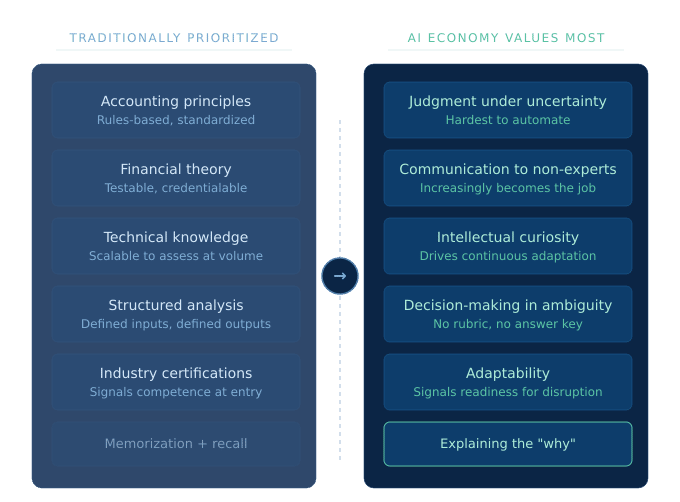
The irony of AI is that it increases the value of the very capabilities that are hardest to standardize, test, and scale.
I remember being at the tail end of my undergraduate degree when the Assistant Dean of the business school visited a meeting for my business fraternity. He told us the number one goal of the college was simple: help students secure their first job after graduation.
That goal shaped the curriculum. A traditional finance education is built around concepts that can get you that first job and can be taught consistently, tested objectively, and measured at scale. Accounting principles. Financial theory. Technical knowledge. Model building.
What it often struggles to develop systematically are the skills that matter most in ambiguous environments: judgment, communication, decision-making under uncertainty, intellectual curiosity, and the ability to explain complex ideas to non-experts.
Those skills have always mattered. But historically, organizations expected employees to develop them on the job through experience, mentorship, and exposure. That was the employer’s responsibility, not the university’s.
In the AI economy, those skills will increasingly become the job.
Another irony is that universities have known this for decades. Every mission statement mentions critical thinking and communication. Every liberal arts dean will tell you those are precisely the capabilities their programs develop.
Yet labor markets have historically rewarded technical credentials more heavily than those altruistic human skills. Students responded rationally by pursuing more technical fields of study. Universities responded by reinforcing those pathways.
Now many of the skills that were easiest to standardize and credential are also the ones most susceptible to automation. As I shared in a previous newsletter, crediting Anthropic, accounting and finance are among the most vulnerable.
The correction will be slow, because universities are slow institutions. Curriculum reform requires faculty committees, accreditation reviews, budget approvals, and years of implementation. It’s taken many years just for state boards of accountancy to simply reduce the CPE eligibility rule from 150 credit hours back down to pre-Sarbanes Oxley 120 credit hours. They’re rushing to make accounting more attractive given the reported accountant shortage. But it’s taken years to get here.
The market will not wait for bureaucratic processes.
The professionals who recognize this early — and deliberately invest in judgment, communication, adaptability, and decision-making — will be better positioned for what comes next. Not because of where they went to school, but because they paid attention to what was actually changing right in front of them.