Is Your Capex Plan Effectively Driving the Forecast?
When I go into a new client and am tasked with putting together cash flow projections or rolling forecasts, one of the most material elements is capital expenditures (capex). Capex is obviously more than hard-coded spreadsheet entries in Excel. They reflect major strategic decisions, operational changes, and long-term commitments to enhance growth and, ultimately, the business’s future.
However, capex schedules are often disconnected from the financial forecast. At least, that’s been my experience. It’s not that the CFO or FP&A modeler doesn’t acknowledge the commercial connection. It’s that modeling-wise, there’s a static relationship.
When this occurs, the model becomes mechanical, and FP&A can become unintentionally reactive.
This week, we will discuss how to build a capex planning that effectively drives the forecast.
A Capex Schedule Is More Than a Line Item
To get started, finance teams can take practical steps:
- Review the fixed asset register. For small- to mid-sized companies, this may involve reviewing each asset. Or it may mean reviewing assets by categories. For larger corporations, this can be an arduous task. So I often recommend sitting down with the operations manager who has oversight and using these conversations to best understand the current state.
- Evaluate quarterly and yearly strategic initiatives. As many in finance and accounting know, capex is usually segmented into strategic (ie, investment) capex and maintenance (ie, recurring) capex. Looking at assets in isolation, without consideration for quarterly and strategic growth plans, turns capex planning into a highly reactive exercise. It puts the focus more heavily on maintenance capex. By reviewing higher-impact plans of leadership, this helps FP&A understand which assets in place facilitate achievement of these plans. And what further investments will be required.
- Review your current capex schedules for accuracy and alignment with business goals. Ideally, departmental heads will already have strategic plans in place and will have discussed what capex or growth investment will be required. But that’s not always the case. Especially for small- to mid-sized companies, I’ve often found myself assisting the team in developing one of these capex forecast schedules in the first place.
We identify what capital projects are necessities versus which are discretionary. We then put estimates on and assess:
- All-in costs and installments
- Timing of deployment
- Amount of lead time necessary in advance of the deployment
- Operational relationships
- Timing/degree of those operational changes
- Key stakeholders involved
We then want to ensure those involved agree to these elements and contribute their understanding of what hits the forecast model. Beginning with this sort of collaborative review can quickly reveal gaps or assumptions in the planning process and set the foundation for more dynamic, actionable decision-making.
Here’s a practical example:
A $20 million factory upgrade consists of many cost components, not just a single figure:
- Maintenance costs
- Installation
- Equipment
- Software
- Training
- Down time
It also involves assessing the operational impact of this upgrade. What does it mean for utility spend, longer-term maintenance costs, hiring, capacity, utilization, scrap, logistical changes, and more?
If these underlying components are unclear, the forecast will most definitely be inaccurate. And if it’s inaccurate, it’s unreliable. It’s rolling the dice and hoping for the best. Effective capex planning breaks investments into their actual components and links them to operating impact, balance sheet changes, cash flow timing, and P&L effects.
Planning within planning:
While the $20 million facility upgrade may be the all-in cost of this growth play, it certainly includes many different capex investments – a few or maybe hundreds – that add up to the total. But this total and the components aren’t just important for cash flow purposes. They are imperative for P&L and balance sheet planning, too.
For example, consider a $2M equipment purchase. Allocating the cost across the expected useful life as depreciation will immediately flow through to the P&L, while the outstanding payment obligations shift the cash flow forecast and alter the asset base on the balance sheet. By capturing this detail, the planning model can show exactly when expenses hit, how they affect EBITDA, and when cash leaves the business. When doing this across all of the projects within the facility upgrade, you then have a granular runway that others can audit and collaborate on.
A strong schedule provides context, explaining both the amounts and their purpose.
Timing, Lead Times, and Cash Flow Reality
Major investments are seldom paid in full up front, especially for large projects that take months to become operational. They involve deposits, installments, delivery schedules, and ramp-up periods.
Order and delivery dates may change, lead times can extend, and payment schedules often shift.
If the model does not reflect these timing adjustments, the cash flow forecast becomes unreliable. Planning should always move beyond static budgeting and become dynamic decision support.
Depreciation and Pre-tax Earnings Impact Matters
If you’ve come to any of my live cohorts, you’ve heard me diminish the importance of depreciation in financial planning. It’s not that depreciation doesn’t matter – quite the contrary for tax strategy and asset replenishment. But for cash flow purposes, it’s not as much of a priority.
While applying depreciation as a flat percentage of revenue is simple, it overlooks the actual useful life and structure of investments. A more accurate method calculates depreciation by asset or asset category and creates a detailed schedule. So I sometimes make the recommendation to start with high-level run rates; however, as time passes and we refine the capex plan, it makes sense to calculate depreciation with accuracy.
Capex Should Not be Considered in Isolation
As mentioned above, capex is never just a cash outflow. It has impacts elsewhere in the business:
- Expanding capacity
- Unlocking new revenue channels
- Improving operating margin
- Reducing maintenance or labor costs
If the capex schedule does not directly link to revenue contribution or cost savings, the financial model remains incomplete. That’s why I tend to suggest the use of operational mapping to tie the capex to what it hits elsewhere in the model. When doing this in Excel, it’s often a scenario toggle that lists out the line items on the P&L and/or balance sheet. That way, we can turn the impact on or off, quite literally at the click of a button.
Focus on Planning, Not Features
FP&A is about applying intelligence, informed decisions, and precise timing. Even simple tools – such as Excel spreadsheets, Google Sheets, or dedicated FP&A software – can significantly improve clarity. Consider using:
- A capex schedule that feeds directly into the forecast
- Dynamic listings that reorganize automatically
- Form control checkboxes that toggle assumptions on and off
- A financial forecast that instantly updates when a project is delayed or activated
These are essential tools, not optional features. As I often say to clients and my mastermind groups, “One, you want to anticipate the questions that others may ask of you and the forecast model, and build the model to answer them. Two, you want the model to be primed to answer questions that may arise during meetings.” This ensures that the model is a dynamic decision-making tool, and not just a spreadsheet that takes hours, days, or weeks to bring in new assumptions. These tools enable CFOs to assess the impact of decisions immediately and with confidence.
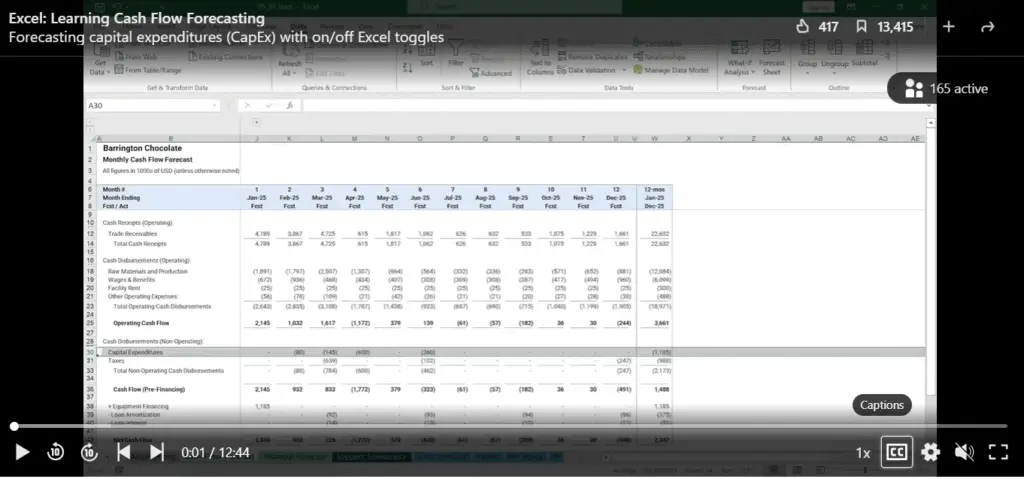
This capex planning walkthrough video demonstrates how to build a detailed capital expenditure schedule that integrates investment timing, depreciation, and operating impact directly into the balance sheet, P&L, and cash flow forecast.