29 Predictions: How AI Will Split Higher Education Into Winners and Losers
Predictions #7–9: Not All Schools Lose the Same Way
Disclaimer: The following views and opinions are my own and do not reflect the views or opinions of any professional organizations or enterprises I work/partner with.
Prediction #7: Elite University Brands Survive and Thrive While Tier 2–4 Schools Struggle to Remain Competitive
Some of the “college is dying” conversation dramatically overstates what’s actually happening. Harvard, Stanford, Columbia, Kellogg, Wharton and their peers are not disappearing. Not anytime soon.
Today, elite degrees serve well in multiple ways.
They signal intelligence, discipline, achievement, and the ability to compete in highly selective environments. For decades, investment banks and other employers have relied on top universities as a talent filter, using admission to these institutions as evidence of a candidate’s potential and performance.
The employer doesn’t need to do mass-scale interviews across hundreds of schools. They can pick the dozen or so that keep the bar sufficiently high and narrow down the candidate pool.
AI puts pressure on that model.
As AI performs more technical work and alternative educational pathways produce increasingly capable professionals, the traditional signaling power of a degree may weaken. If the students themselves are learning mostly through, or with the help of AI, what makes the education that valuable in the first place? And if students at a tier four school are learning the same way, what makes them any less qualified? It probably doesn’t.
Employers may need to rely less on educational pedigree as a proxy for capability and more on demonstrated outcomes. But elite universities will survive for a reason that’s harder to replicate: network and pre-college positioning.
The next comments may strike some readers as unfair. They are, however, based on patterns I’ve observed repeatedly and believe are at least partly accurate.
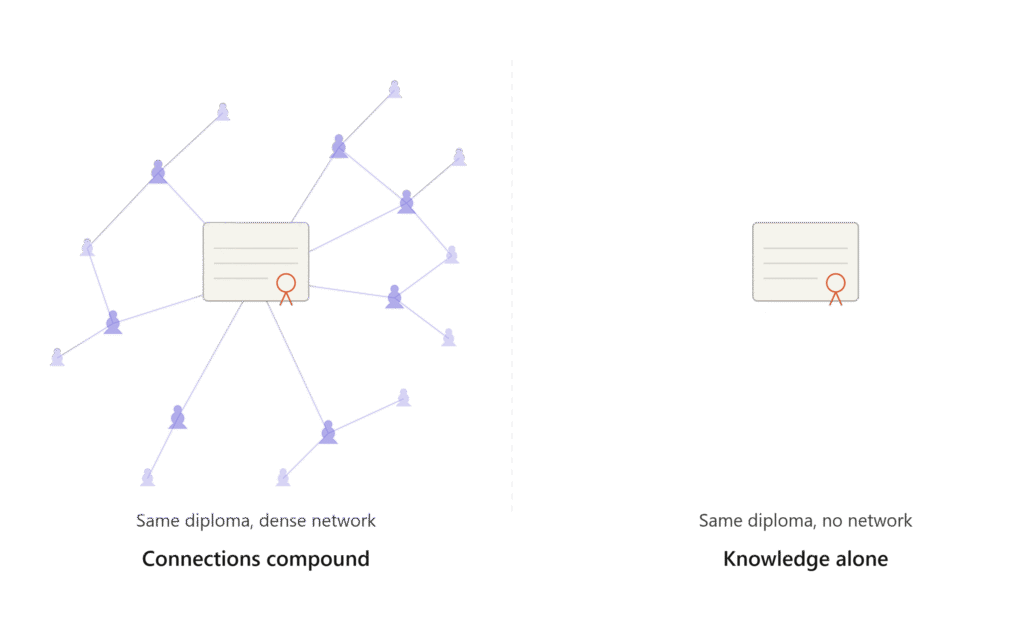
The relationships formed at those higher-tier institutions — classmates who later become executives, founders, investors, and board members; faculty with deep industry influence; alumni networks that function as informal hiring pipelines — are not easily recreated through an online course, certification program, or AI tutor.
They’re built through proximity, shared experience, and years of relationship development.
Further, top-tier universities are also known to give priority to the pedigrees of students they want among their ranks. It’s not always based on SAT scores and grade-point averages. Oftentimes it is. But, of course, there are exceptions.
The implication is that the elite degree may increasingly derive its value from access to people rather than access to knowledge.
The accounting concepts, valuation methods, and financial modeling techniques taught at a regional university are often not dramatically different from those taught at an elite institution. Knowledge is becoming more accessible than ever, but relationships remain scarce.
For students who can afford it, and who understand what they’re actually buying, elite institutions will likely continue to provide substantial value. And the payoff may continue to be worth it.
But for everyone else, economics will become more difficult. That’s why I believe the schools most vulnerable to disruption are not the elite institutions at the top, but the large group of expensive schools positioned just below them that charge premium prices without offering the same network advantages.
My wife and I are saving for our kids’ higher education. But it will be interesting to see how it plays out when my kids are looking at college.
Prediction #8: Lifelong Learning Stops Being a Buzzword and Becomes an Economic Necessity
“Lifelong learning” has been a corporate talking point for decades. HR departments put it in their mission statements. LinkedIn built an entire business model around it. Universities have found a value proposition and great new revenue channels through certificate programs, continuing and executive education.
Most organizations encourage it. But in practice, it has often meant something less ambitious than it sounds:
Take the occasional course, earn a certification, update your profile.
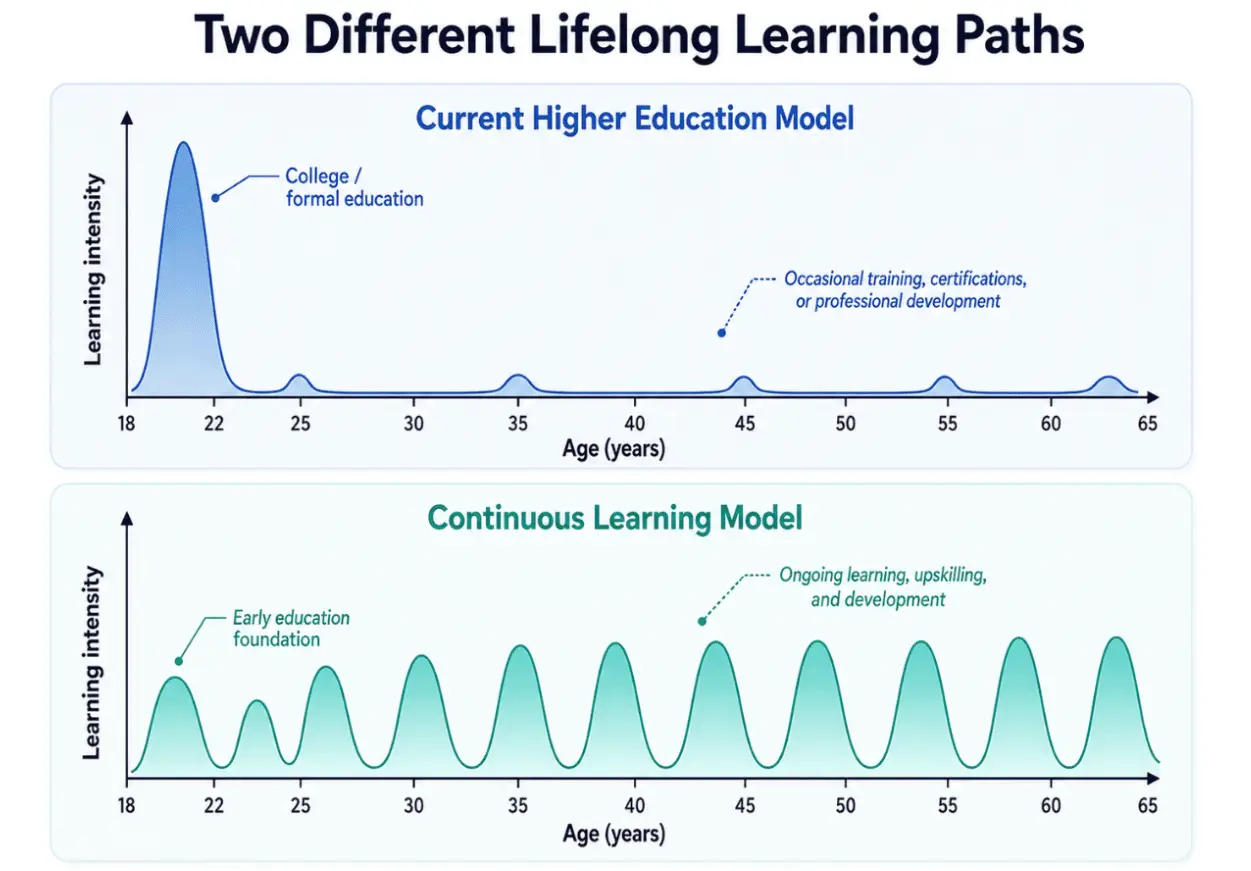
That model doesn’t work as well in a world where AI can accelerate the pace at which skills are learned and become outdated. The finance professional who mastered a tool, workflow, or process three to five years ago may discover that significant portions of that expertise have already changed with new technology. Accounting rules aren’t changing, but the environment accountants work in is.
What I’m describing, and hopefully predicting, is a fundamentally different relationship with education — one where learning isn’t front-loaded into your early twenties and then supplemented by the occasional seminar. It’s continuous, targeted, and driven by what the market actually needs from you right now, not what it needed when you got your degree.
I even question whether four years of sequential, linear programming makes sense at all anymore, or whether young people would benefit more from one- to two-year educational bursts spread out over time.
The problem I see is that the infrastructure built around the old model doesn’t serve the new one.
Universities are optimized for cohorts of 18-to-22-year-olds sitting in classrooms for four years. Corporate training programs are optimized for annual compliance cycles. Neither is built to deliver fast, relevant, personalized skill development to a 35-year-old Director of FP&A who needs to understand AI-augmented financial projections well enough to manage a team using it.
Sure they can learn AI prompting in a day. But in my personal experience, even learning AI is rapidly changing and quickly outdated. I produced LinkedIn Learning’s first Copilot for Excel in FP&A course 18 months prior to me writing this newsletter. And it’s already very outdated.
The providers who figure out how to serve continuing education — specifically, credibly, cost-effectively, and efficiently — are going to build something significant. They’ll meet the needs of a population where a four-year degree might no longer make sense.
Most existing institutions aren’t positioned to do this. I think they need to be.
Prediction #9: The Most Successful Young Professionals Optimize for Capabilities, Not Credentials
This is the prediction I feel most strongly about. And it has the most immediate implications for how we advise young people today.
“Where should I go to college?” is a legacy question. When I was asking it, the decision largely came down to three things:
- What were the best schools I could get into?
- Which ones could I afford?
- Which had strong programs in the subjects that interested me?
Like many 18-year-olds, I knew very little about the career path I would ultimately pursue. My idea of a career path was very much tied to what I was exposed to as a child – my parents’ and grandparents’ vocations, and my friends’ parents’ vocations.
Looking back, what’s striking is how much of the discussion centered on selecting a job or a credential, rather than building transferable skills or capabilities.
For previous generations, that approach worked reasonably well. A degree was often a reliable proxy for employability, and the return on investment was relatively predictable. I believe it becomes less reliable going forward.
The ROI of a degree increasingly depends on the specific institution, the specific field of study, the cost of the degree, and the market value of jobs it can lead to. And, of course, what a student does with the degree after school.
At the same time, alternatives to traditional higher education are becoming more credible, albeit not a full replacement:
- Apprenticeships
- Bootcamps
- Community or regional college transfers
- Entrepreneurship
- Self-directed learning
- Early-work experience
None of these options are universally superior. But many are becoming, and will continue to become, more viable than they were even a decade ago.
As AI makes knowledge more accessible and technical skills easier to acquire, the question becomes less about which credential you hold and more about what you’re actually capable of doing. As I shared in my last newsletter, instead of focusing on picking the right college to attend, better questions for many young people may be:
- What problem do I want to solve?
- What skills does that require?
- What are my unique strengths?
- What combination of education, experience, and community helps me develop those capabilities most effectively?
For some, the path forward is still a four-year university. For others, it won’t be. And a healthy educational ecosystem should be capable of supporting both paths.
I teach graduate-level data analytics and genuinely love that work. I still believe higher education can be transformative. But transformation tends to happen when education is pursued intentionally rather than by default.
That distinction has always mattered. In the AI era, I think it matters more than ever.
We owe that to our young people. And to paraphrase Ronald Regan, if we want to continue to be the shining city on the hill – to be the society that we want to be and that other societies look to for inspiration – we need to be positioning ourselves for what’s next.
Not to double-down on complacency and a system that once worked better than it does today.