29 Predictions: How AI Will Collapse the Online Finance Education Market
Predictions #10–14: The Online Finance Education Market Is About to Look Very Different
This issue shifts to the market that many finance professionals have turned to instead: online courses, training platforms, and self-paced learning.
The outlook here is not much better. In some ways it’s more precarious. I hope my rationale explains why I take the position that I am.
Disclaimer: The following views and opinions are my own and do not reflect the views or opinions of any professional organizations or enterprises I work/partner with.
Prediction #10: AI Commoditizes the Asynchronous Recorded Finance Course
Recorded video content has been the backbone of online course platforms like LinkedIn Learning, Udemy, and Coursera for more than a decade. They’re sometimes referred to as Massive Open Online Courses, or MOOCs for short. The asynchronous content allows companies to sell more units without having to invest a dollar in additional overhead.
They’ve been among the highest-margin products in education, which is why there’s been so much interest in them versus live or hybrid courses.
But I believe this format is at risk of significant commoditization — still technically available, still occasionally useful, but no longer the primary vehicle for learning. Why? Because AI can now create these courses quickly and at scale.
Go onto YouTube, and you see beautifully produced, rich-content videos published within hours of major news announcements. People aren’t superhuman in their content creation – they’re leaning on AI to do it for them.
What we don’t know is whether the creators actually know anything about the topics they’re making videos about, or whether AI is the stand-in.
I want to be transparent about how close this prediction is to home. Today, I can use AI to create a course script in thirty minutes, trained on my own content. I can then use AI-enabled video production software to create professional video lessons — with or without appearing on camera. I’ve built an AI assistant using Claude, GitHub, and Vercel that can answer follow-up questions from learners while I’m sleeping.
I can tell you first-hand- because I’ve already built it- we’re now going to see AI agents and bots make their way into digital learning. A student can interact with a real-time AI tutor that answers follow-up questions, adjusts its explanations, generates practice problems, and adapts to an individual’s learning style.
A static four-hour video course simply can’t compete on learning outcomes with courses that are so enhanced.
If I can do this, thousands of other instructors can too. And so can adolescents who may know little to nothing about the content but who are wizards with technology, monetizing on YouTube through massive traffic.
When the supply of educational content becomes effectively unlimited, the economic value of any individual course trends toward zero.
For companies that are in the financial education space, this means digital learning is going to have to compete more on trust, brand recognition, discoverability, and distribution. That means the recorded course increasingly becomes a trust-building asset rather than the product itself.
More and more content is going to be absolutely free.
Recorded courses won’t disappear. But I believe they’ll increasingly serve as marketing assets that build trust, demonstrate expertise, and introduce learners to higher-value offerings rather than functioning as meaningful standalone revenue streams.
Prediction #11: The Large Content Platform Aggregators — LinkedIn Learning, Udemy, Coursera — Lay Off More People and Either Consolidate or Become Irrelevant
The signals are already visible. LinkedIn Learning has gone through multiple rounds of layoffs. Udemy and Coursera recently announced plans to combine. Microsoft, which owns LinkedIn, has committed to hundreds of billions of dollars in investment in AI and capex. The courses are already inexpensive and I suspect AI crawlers are harvesting the content at scale.
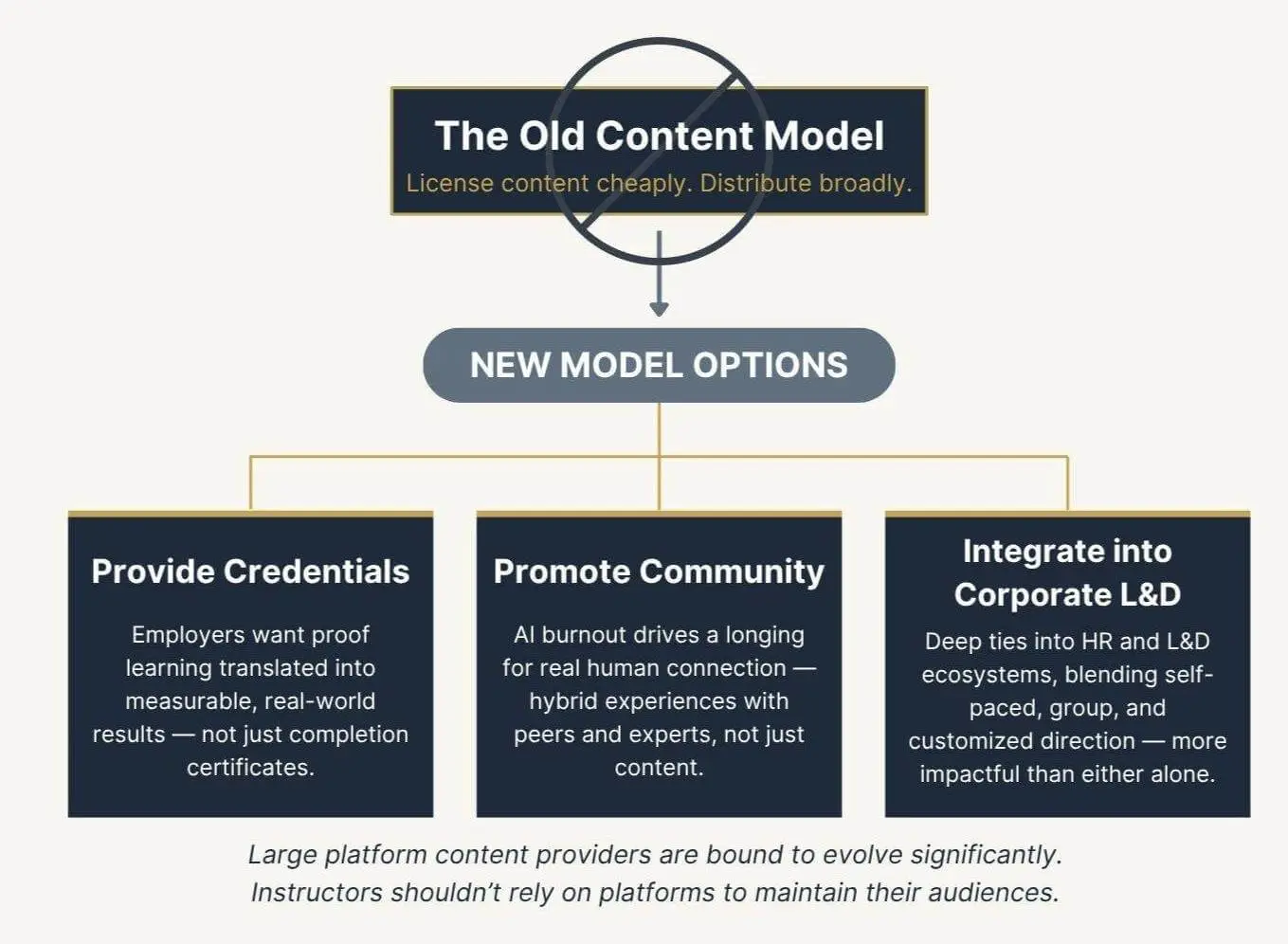
The current business model of these platforms — license content inexpensively from instructors and distribute it to large audiences — breaks down when AI can generate comparable content endlessly at zero marginal cost. The next business model is unlikely to need thousands of new instructors. It just needs to repurpose and repackage their existing teachings to become the largest library of professional education ever created.
I believe the platforms that survive beyond zero-cost content may pivot toward one or more of three new core models:
- Credentials that employers genuinely value. Traditional learning is hard to adequately measure through before-and-after assessments. But employers need to actually see and measure the results of their people going through learning and development to determine what customized learning paths need to look like for each individual.
- Communities that bring together hybrid experiences. In my discussions lately, there’s increasingly a sense of burnout around AI. It’s everywhere. It permeates daily conversation. And I believe this will lead to a greater longing for human connection and experience. Learners will have access to a massive archive of always-evolving content, but they may also benefit from access to other learners, experts, and synch/asynch experiences.
- Deep integration into corporate learning and HR ecosystems. The traditional model of sending people to training and hoping they learn doesn’t provide the value that AI-enhanced and hybrid learning likely can. The combination of learning on their own, with a group, and with the support of customized direction deep in the learning & development (L&D) ecosystem may make L&D more impactful than was previously possible.
Udemy has already shifted much of its business toward enterprise B2B licensing rather than individual B2C course sales. I suspect that’s an early indicator of where the industry is heading – integration, not massive access.
The instructors who built their entire audiences on these platforms — without building an audience off them — may find themselves stranded. Those who built direct relationships with their audiences will remain relevant regardless of what happens to the platforms underneath them.
Prediction #12: The Finance Influencer and Education Market Explodes — and Then Implodes — Within a Few Years
As I shared in prediction #10 above, AI makes it dramatically easier for almost anyone to look like an expert.
The low barrier to AI-generated content is already creating a surge of finance educators online. Type “Claude Fable 5 for Finance” into YouTube and you’ll see an overwhelming number of people sharing their latest tricks and so-called “expert secrets revealed.” But the truth is that, as of the time of this newsletter issue, Fable 5 is brand new and no one is an expert.
The majority are producing indistinguishable material: AI-written scripts, AI-produced images, AI-designed infographics, and AI-generated text overlays. Some are even synthetic AI videos, where the person’s face looks like they’ve had Botox and it’s only their lips moving with subtle facial micro-expressions.
As referenced above, the marginal cost of producing this content is going to approach zero, which means the supply is going to become overwhelming.
Today YouTube is the world’s second-largest search engine (#2 behind Google, and Alphabet owns both). The number of finance education videos published there is going to skyrocket. But my greatest wonder is…what’s going to matter in the long run? Does a large following represent genuine expertise? Or does it simply represent the ability to attract attention?
On a platform that monetizes views, it may not matter. But for people who want to follow authentic expertise, it may. In the short term, audiences may not be able to tell the difference. But over time, they will.
My expectation is that the market eventually collapses around a relatively small group of trusted voices with demonstrated expertise, authentic communities, and a track record of producing real outcomes. The rest — regardless of follower counts — may discover that attention without trust doesn’t convert into a sustainable business.
There will be that desire for human connection with people who actually know what they’re talking about. Or those who are entertaining. Or maybe both.
Interestingly, AI is already able to help audiences analyze and identify who among the field actually has credible authority. And that capability will only improve.
Prediction #13: Cohort-Based Learning Programs Become a Dominant Premium Format for Learning and Development — But Most Will Fai
As AI commoditizes educational content, the market will increasingly recognize the value of what AI genuinely cannot replicate: live interaction, peer accountability, meaningful discussion, and direct access to experienced practitioners.
As a result, I believe we’ll see a surge in cohort-based learning programs, but many of them will fail. The mistake will be assuming that getting on a live Zoom session is enough to create a premium learning experience.
But I can share from personal experience that it’s not.
Building a successful cohort program is operationally complex. It requires thoughtful facilitation, consistent engagement, meaningful peer interaction, follow-up, and a level of trust that encourages professionals to invest both their time and their funds.
The programs that succeed will likely be smaller than most founders expect, priced higher than today’s market is accustomed to, and built around a singular trusted expert – or a small number of trusted experts – rather than a platform brand.
In an AI-driven world, as I’ve shared thus far, people won’t pay a premium simply to consume digital content and information. They’ll pay to learn from someone they trust, alongside peers they can learn with, in an environment that challenges them to apply what they’re learning. With the widespread adoption of Zoom, Teams, and other virtual platforms, we now have access to these experiences all over the world from the comfort of our homes.
Prediction #14: The Finance Training Market Bifurcates Sharply and the Middle Disappears
This is arguably the most profound structural prediction in this category because it has direct implications for anyone currently building or buying finance education.
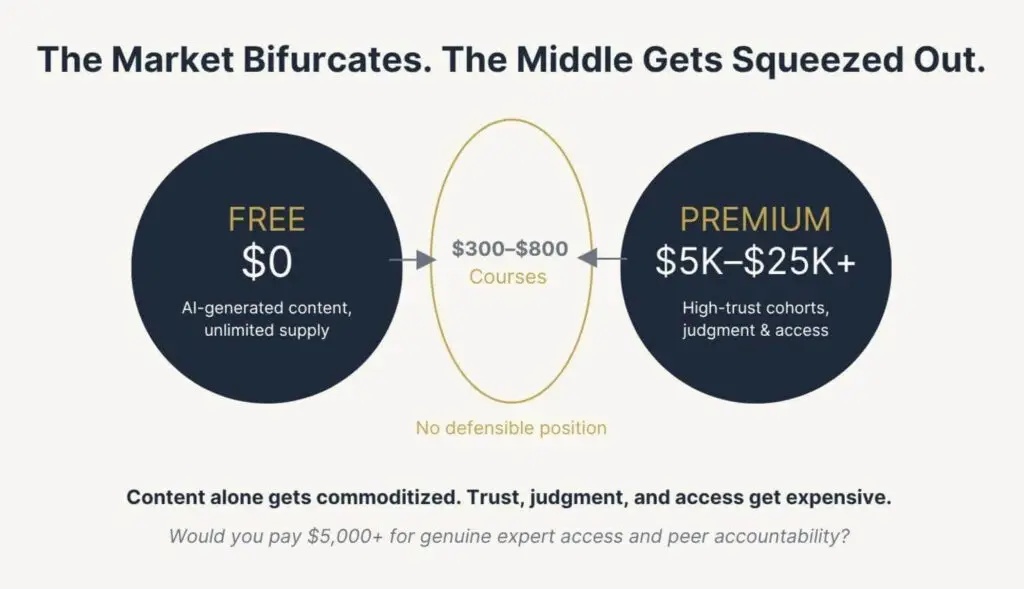
AI doesn’t eliminate demand for education. It’s perhaps the opposite because people will need to better understand the outputs that AI gives them. But it does eliminate the demand for premium-priced content for information alone.
On one end of the market will be a flood of free (or nearly free) AI-generated educational content covering every technical finance topic imaginable. It will be good enough for professionals looking for a specific answer. It will also probably be good enough for younger people who need foundational guidance.
But once they get what they need, they’ll move on. They won’t pay large sums for a course to get information they can access for free in thirty seconds.
On the other end of the market may be high-trust, high-touch cohort programs, advisory communities, and premium learning experiences priced at $5,000 to $25,000 or more. People won’t be paying primarily for content. They’ll be paying for judgment, accountability, community, feedback, and access to experienced practitioners.
The traditional $300 – $800 self-paced course, which has been the heart of the online education market for the past decade, gets squeezed from both directions. There’s no defensible position in the middle.
Content that used to justify that price point is increasingly going to be available for free as it’s cheap to produce and easy to publish. The professionals who want more than free foundational content will need to invest in higher-level learning and development.
I predict that within the next handful of years, the middle of the market will start to look very different