
Prompted, Not Proven – Part 1: Most “AI for Finance” Content Has Never Met a Real Client
Prompted, Not Proven – Part 1: Most “AI for Finance” Content Has Never Met a Real Client
This is Part 1 of the Prompted, Not Proven series in The Statement on what’s real, and what isn’t, in AI for finance content.
It’s everywhere.
If you spend any time on LinkedIn, Instagram, or YouTube, you’ve probably seen it. Countless posts and videos sharing every tip, trick, hack, and technique that we all seem to be missing out on. All you have to do is comment “Claude” and the creator will send you the keys to their treasure chest.
I’ve never commented on or downloaded a single one. Why?
Because I know what’s likely sitting behind the curtain: a Claude guide created by someone who may or may not have relevant experience. AI-generated files, PDFs, cheat sheets, and ebooks with hardly a single fingerprint of human involvement.
In most cases, I suspect they’re just going to Claude and asking it to write about Claude.
The biggest questions I continue to have:
- Are the people sharing these tips, tricks, hacks, and techniques just repeating what Claude tells them?
- Or are they actually using them in their real work?
To be clear, I’m not against learning about AI from others. I read newsletters from people who write frequently about AI, finance, futurism, and how they all connect. They help me stay current in an extremely fast-moving space. They challenge my thinking. And they make me question the accuracy of what others are saying.
I also pay close attention to announcements from Anthropic, OpenAI, and Microsoft. When you want to know what a tool can do and how it works, it’s usually wiser to go straight to the company that built it. Of course, they have their own interests too. What a feature does and how well it holds up in real finance work are two different questions, and that second question is where practitioners come in.
The Disappointing Truth Around What I See
It’s one thing to prompt Claude: “Build me a cash flow forecast.”
It’s another to actually use that forecast, outside the safety of the chat window, for a client who pays five figures for it and relies on it to steer the business. Just because something looks good doesn’t mean it’s good enough to use in real-life finance.
So why are so many people confidently sharing work that doesn’t survive a closer look? I think part of it is that the AI output looks finished. The formatting is clean, the formulas calculate, and nothing flashes red. And unless you’ve spent years watching models break under real-world pressure, like a lender’s questions or a missed quarter, you may not know what’s missing.
I also believe it’s because people are so hungry to understand AI that they’re eager to consume anything that seems genuine. But once they pull back the curtain, it’s often lipstick on a pig.
I Was a Sucker
Over the past couple of years, I’ve enrolled in three AI learning experiences. I signed up for two of them out of interest and a belief in what I thought I’d learn. The third was a chance to learn alongside a highly reputable expert who truly knows his stuff.
The first two left me feeling swindled. The third had tremendous value.

Experience #1
The first AI course I enrolled in was taught by a fellow heavy Excel user. The videos had great production value. They were polished and genuinely enjoyable to watch.
But the substance was absolutely missing. The course was mostly screenshots of what different Excel buttons do and a tour of the newest features Microsoft had added.
When I finished, I had to admit the truth: there was very little an actual accounting or finance practitioner would implement in real life. I later learned the instructor had only a few years of actual hands-on work experience.
Experience #2
The second course was taught by someone with a large LinkedIn following. I’d attended one of his webinars, where he showed process workflows I thought could be useful in my own business.
So I signed up.
But I quickly found the instructor’s teaching biased, as I realized the teaching was built entirely around one piece of software. Not Claude. Not Copilot. Not ChatGPT.
To his credit, the software had a good reputation and integrated with other tools I use. But the course turned out to be little more than an extended sales pitch, capped off by the software’s co-founder joining office hours to promote it.
Months later, the co-founder announced the software was shutting down and he was joining a Fortune 500 company. Every workflow I’d learned was tied to a tool that no longer exists.
Experience #3
Having learned my lessons from the first two, I decided to learn directly from a data analytics leader and former Microsoft executive. It seemed logical, right? To actually learn from someone who does – for a living – what he’s teaching?
We met live on Zoom for several months and worked step by step through building financial skills, workflows, and files that would be client-ready. It wasn’t fluff. It wasn’t conceptual. It was tangible deliverables I could actually put into practice at companies.
We still stay in touch, share notes, and encourage each other. He’s about 10 years my senior and helped me connect dots I hadn’t been able to connect on my own.
That experience gave me the question I now ask about every piece of AI content I see: has the person sharing it actually done the work?
The Same Model, Over and Over
Earlier this year, when I really started pushing the model-building capabilities of Claude and Copilot, I asked them to create generic versions of the tools I’ve built manually over many years:
- Cash flow forecasts
- 3-statement integrated models
- Headcount plans
- Capex forecasts
- And more.
Using synthetic (i.e., fake) data, the tools come out of the gate at blazing-fast speed and build very realistic-looking models. The layouts are reasonable, the formulas are decent, and the logic mostly makes sense. Even the company, customer, and vendor names sound real.
If you were to put this in front of a finance or accounting novice, they’d probably believe it. They might even think a human built it. What they wouldn’t see is that the data is made up, the logic is only partly right, and the model has never been tested against the messiness of a real business. It’s not ready for prime time.
In recent months, I’ve seen two models shared publicly by others that look almost identical to the ones I had Claude build for me.
- Same layout
- Same formatting
- Even the same fictional company and vendor names
I couldn’t believe what I was seeing. Not because I felt these two people had copied what I shared on LinkedIn, but because Claude seems to produce nearly identical outputs when different people give it similar requests. Not to mention, when I shared mine, it was to show what the tools can do out of the box, not as something I’d ever hand to a client.
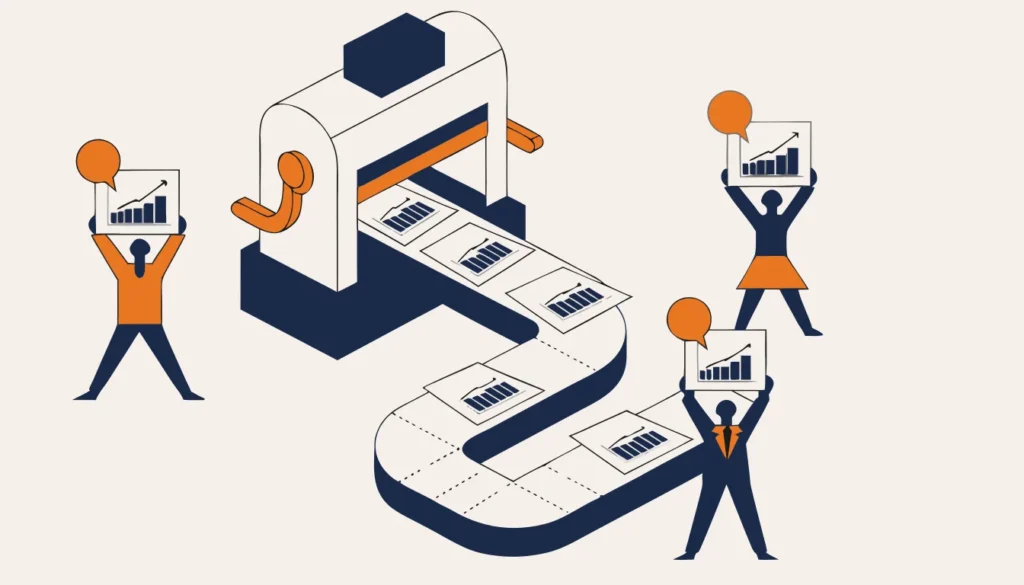
To that point, it really bothered me to see the faux models being shared by others claiming “this is how I’m doing X in AI for finance.” I have a hard time believing they’re actually using those models in real client work.
Which brings me back to my original question:
How much of the “this is how I do X in AI for finance” is actually being deployed in real businesses? And how much is just someone typing commands into Claude, taking the output, sharing it with thousands of followers, and convincing them that it’s worthy of putting in front of a manager or client?
Looking back, my three AI course experiences were an early preview of what I’m seeing everywhere now. The first program was polished but empty, much like a model that looks client-ready and isn’t. The second was built to sell a product more than to teach, much like content designed to collect followers rather than build skill. Only the third came from someone who does the work for a living, and it’s the only one that changed how I work.
That’s the test I’d apply to every AI tip, template, and model in your feed: has the person sharing it ever put it in front of a real client?
It also raises two bigger questions:
If AI can produce financial deliverables that look 70–80% of the way done, and are easy to build on, where does a professional belong? Is it only in that final stretch of customization?
If AI produces extremely similar outputs for everyone who asks, what separates one professional from another?
These are major questions, and they point to major disconnects. I’ll tackle them in the next two issues of this series.
Questions for You
- Have you ever bought an AI course or downloaded a guide that didn't hold up in real work? What gave it away?
- And when you see "here's how I use AI" content, how do you decide whether to trust it?