Does AI Signal the End of the Accounting, Management Consulting, and Investment Banking Professions? Part 1
Part 1: When AI Learned to Read the Spreadsheet
About six months ago, a Principal at an SF Bay Area venture capital firm reached out to me and proposed.
Not nuptially.
He wanted to buy my financial models.
I was taken aback by the offer. I had never received that kind of request before. Naturally, I asked a few questions:
“What models are you looking for? And what are you planning on doing with them?”
The response surprised me even more.
“All of them,” he said. “We want to use them to train our AI.”
As I continued asking questions — what the AI would do and what the models would be used for — it became clear that they were building a next-generation financial analysis tool.
I concluded that without a fuller understanding of exactly what my files would be used for, I couldn’t agree to it.
…but looking back now, I probably should have.
Fast Forward Six Months
Anthropic recently announced that its Claude AI engine is now available as an add-in to Microsoft Excel. The company had been beta testing this for months before rolling it out to the masses.
Naturally, many of us in the FP&A, accounting, and financial modeling profession were eager to see what it could do. Excel is the backbone of financial analysis, and the idea of AI embedded inside it holds enormous potential.
But for those of us in the Microsoft MVP circle, we were especially curious (and cautious) about its capabilities.
How good could it really be?
After all, Microsoft’s own AI assistant, Copilot, hasn’t been quite as powerful as many of us hoped.
Would Claude be any better?
Yes. Remarkably so.
I uploaded two models.
The first was a forecasting model I built for a firm providing Fractional CFO and outsourced accounting services. It projected revenue, utilization, and capacity across different service lines.
The second file was simply a PDF reporting package for a hospitality management company.
In seconds, with my back-and-forth prompting, Claude analyzed the Fractional CFO model with near-perfect accuracy. It suggested improvements to make the model more robust and even highlighted potential weaknesses in the firm’s operations.
With the hospitality reporting package, it took hard-coded figures from the PDF and converted them into a workable Excel model. It took about 5 minutes.
It wasn’t remarkably advanced, but it was an impressive starting point.
Since then, OpenAI has announced its own add-in for Excel.
The Rapid Progress of AI Tools
Experiments like these have pushed many of us to explore the broader landscape of AI tools. Across the four major platforms — Claude, Copilot, ChatGPT, and Gemini Ultra — it’s clear that these systems are rapidly improving in their ability to analyze and generate financial and business models.
For professionals in finance and consulting, this raises a bigger question.
What does this mean for the future of our work?
The Core Skill of Finance
For decades, the core skill in many financial professions hasn’t simply been knowledge of accounting rules or financial theory.
It has been structured analysis.
Finance professionals are trained to take messy, incomplete information and turn it into a structured model of how a business works.
That work may include, but is in no way limited to:
- Building financial models
- Forecasting revenue, costs, and cash flow
- Analyzing operating performance and offering improvements
- Identifying risks and weaknesses in strategic plans
- Turning numbers into summaries and narratives that executives can act on
These tasks require domain knowledge and judgment. But they also follow patterns.
A financial model, after all, is simply a structured way of describing how a business functions. And patterns are exactly what modern AI systems are learning to replicate.
When a large language model analyzes a spreadsheet, it is not “thinking” like a human analyst. But it is identifying relationships between inputs, formulas, and outputs — often far faster than a human can.
The implications of this are significant.
Because many of the tasks performed by junior analysts in accounting firms, consulting firms, and investment banks involve exactly this kind of structured analytical work. Does this mean that junior analysts’ jobs are at risk?
The Work Most Vulnerable to AI
Consider some of the typical responsibilities assigned to early-career professionals in finance and consulting:
- Building and updating Excel models
- Assembling pitch books and presentations
- Summarizing financial results
- Researching industry data
- Preparing reporting packages
These tasks aren’t just the duties for young professionals. They’re the training grounds. They’re how young finance and accounting professionals get exposure and put in the reps to move up to the next level of their careers.
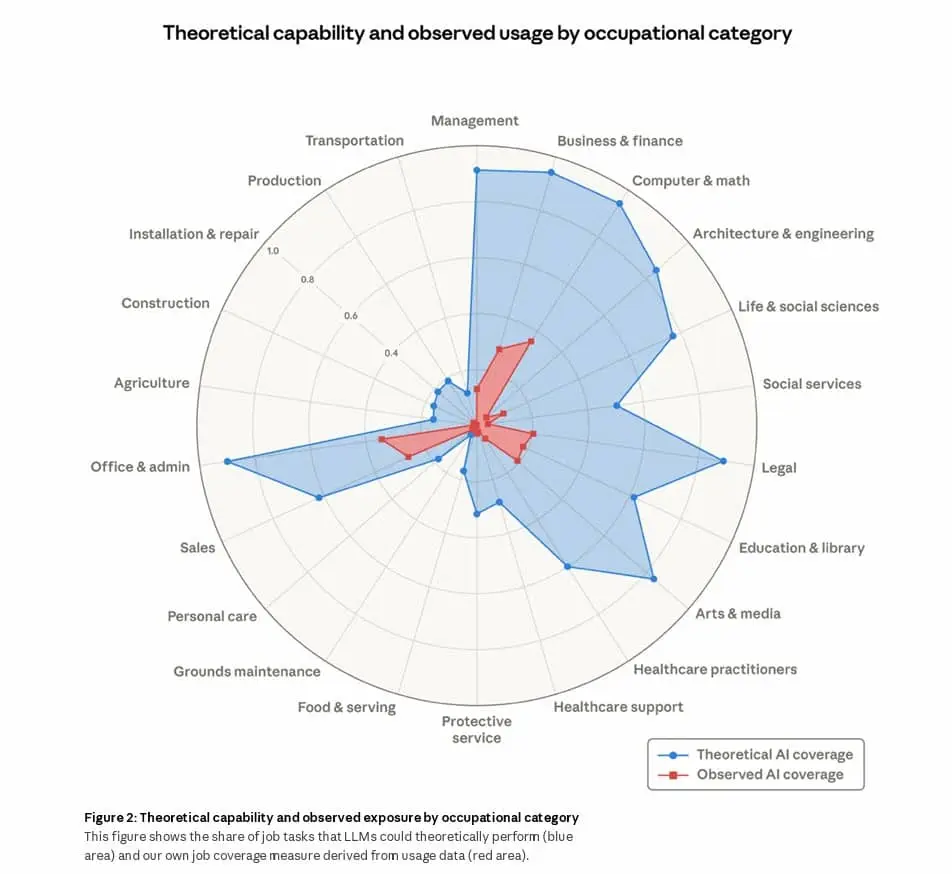
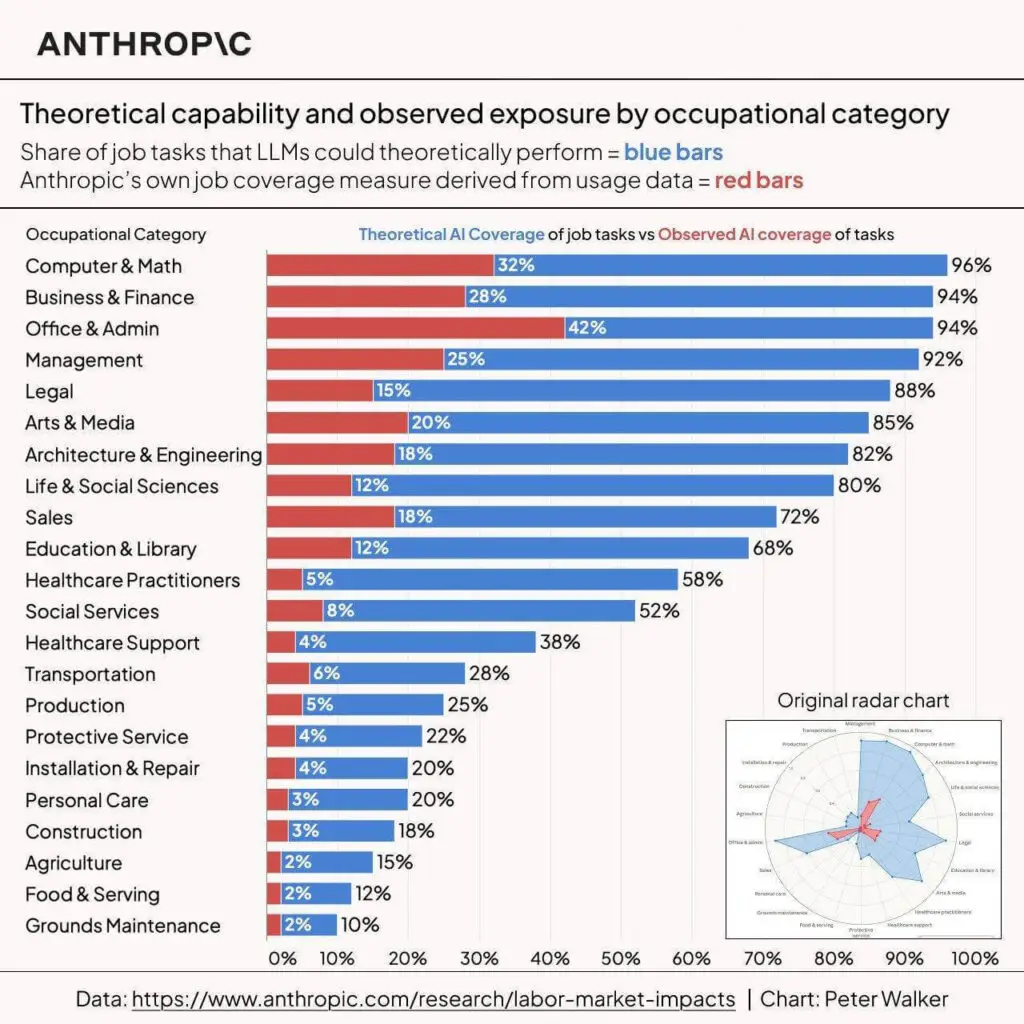
But they also happen to be the kinds of work AI systems are rapidly improving at. As you can see in the images above, business/finance is identified as the #2 top domain when it comes to AI being able to cover most tasks.
Even leaders in the financial services industry have begun acknowledging this shift. David Solomon, CEO of Goldman Sachs, made headlines a year ago when he said that AI could create presentations in minutes that previously took analysts hours to assemble.
When tools can produce that kind of output instantly, it raises a difficult question for professional services firms.
Not whether analysts are valuable.
But whether firms will need as many of them.
The Real Question
If I had to speculate, I believe the disruption AI creates in finance may not come from replacing senior professionals.
It may come from changing the training ground that produces them. And this is a major concern.
For decades, accounting firms, consulting firms, and investment banks have relied on large cohorts of lesser-paid junior analysts to perform analytical work while learning the profession. Like in so many other professions, as elders retire, middle-management moves up into leadership. As middle-management moves into leadership, junior employees move into management positions.
But if artificial intelligence can perform much of the work faster and cheaper, the traditional structure of these firms may begin to change. I won’t say collapse, but I do believe that the future firm will look very different from what we’ve seen over the past couple of decades.
And if that happens, the impact could extend far beyond spreadsheets and financial models.
Because the professions of accounting, consulting, and investment banking have long depended on a simple structure:
A wide base of young analysts supporting a smaller number of experienced professionals.
In the next article in this series, we’ll explore why that structure — the professional services pyramid — may be the next thing AI disrupts.