Does AI Signal the End of the Accounting, Management Consulting, and Investment Banking Professions? Part 2
Part 2: The Pyramid Is Breaking
When I was in college, there were three business careers that deeply intrigued many accounting and finance students.
They promised the ideal combination of being in demand, lucrative, and secure.
The trio was well known:
- Public Accounting
- Investment Banking
- Management Consulting
Students constantly talked about how ideal these jobs were, but often before ever experiencing them firsthand. And professors and career counselors echoed the same, also before ever experiencing them firsthand.
For those of us on the receiving end of this advice, the career path was clear-cut: Study hard. Get good grades. Ace the interviews. And if you get into one of the bigger firms, you’ll be all set as a new hire for at least the next 2-3 years, as you launch into the next stage of your career. In accounting, the traditional path was to join a Big Four or large regional firm, gain a few years of experience, and then move into corporate finance, FP&A, or pursue an MBA. In investment banking and consulting, the path was similar: work as an analyst for two years, earn an MBA, and then return as an associate or move into private equity, corporate strategy, or entrepreneurship. It looked like a clear recipe for success. Until it wasn’t.
When the Recipe Stopped Working
The financial crisis of 2007–2008 disrupted many of these assumptions.
Entire segments of Wall Street contracted. Consulting projects dried up. Corporations froze hiring. Even accounting and FP&A roles—long considered stable anchors inside companies—felt the ripple effects. I remember in my first Associate role, the firm laid off a bunch of people, morale tanked, and those of us who saw the writing on the wall and jumped ship to more promising pathways.
Despite the historical trend that often saw people go back to school when the economy got rough, the value of the MBA also shifted. While the top programs continued to thrive, and even got more selective and expensive, many others moved partially or entirely online as the schools tried to stay competitive.
The broader lesson was simple:
Career advice that feels certain in one era can become outdated surprisingly quickly.
Looking back on that advice I received two decades ago, it now seems like a quaint idea.
The financial crisis of 2007–2008 didn’t just disrupt companies. It disrupted assumptions—about job security, about career paths, and about what it meant to be “safe” in the world of finance.
For a generation of professionals, the playbook changed almost overnight.
Today, we may be approaching a similar inflection point.
But this time, the disruption isn’t being driven by a collapse in financial markets. It’s being driven by a technological shift. Artificial intelligence is beginning to change not just how work gets done—but how entire professions are structured.
And just like in 2008, the biggest risk may not be the disruption itself. It may be assuming that the old playbook still works and going along with outdated assumptions.
The Professional Services Pyramid
For decades, accounting firms, investment banks, and consulting firms have operated on a remarkably consistent structure.
A pyramid.
At the top sit partners and senior leaders. Beneath them are directors and managers. And at the base is a large class of analysts and associates.
This structure wasn’t arbitrary. It was built around the economics of the work.
Junior employees handled the heavy analytical lifting:
- building financial models
- conducting research
- assembling pitch decks
- preparing reports
Senior professionals reviewed that work, advised clients, and made the higher-stakes decisions. It’s an efficient system for delivering high-value services while training the next generation of professionals.
But that system depends on one critical assumption: that the work performed by junior staff requires humans to do it.
That assumption is now being challenged. The Financial Times* recently reported that top consultancies are freezing starting salaries as this model is under threat. (*article access may require subscription).
The Diamond Firm
Recently, a colleague and I discussed what the future structure of professional services firms might look like. I am predicting a massive shift.
Instead of a pyramid, we imagined something closer to a diamond.
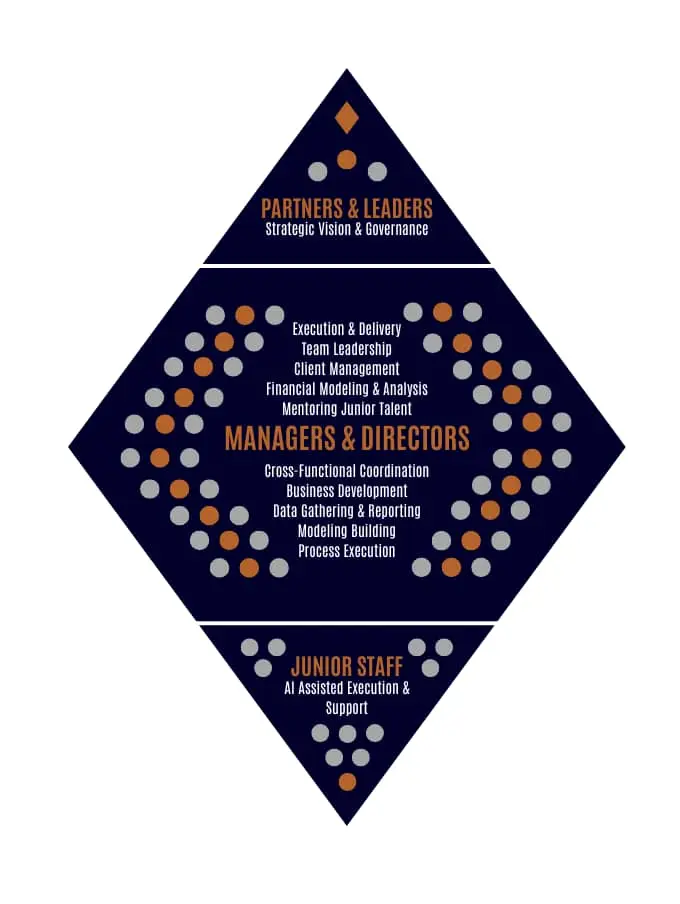
Narrow at the bottom (junior staff). Narrow at the top (leadership). Wider in the middle (Managers and Directors, the architects and overseers).
In this model:
- There are fewer junior analysts performing manual tasks.
- Senior professionals oversee AI-enabled workflows.
- Mid-level experts become more important because they can manage both clients and technology.
- AI systems handle large portions of the underlying analytical work.
A race is going on right now to develop the technological capabilities that will make this possible. It’s not just at the OpenAIs and Anthropics of the world. I already hear this chatter going on inside of the consulting and accounting firms. We might not see the tangible results today, but I would bet we will in a year or two. I see the objective for these firms being greater efficiency and growth through technology, not merely focusing on technology as the ultimate answer.
A Simple Thought Experiment
To see where this may lead, allow me to illustrate a hypothetical using two imaginary consulting firms. They perform identical services. Both generate $100 million in annual revenue. But their cost structures differ dramatically.
- The first firm operates with 1,500 employees and earns a 30% operating margin. It delivers its services traditionally.
- The second firm operates with only 200 employees. Its operating margin is 70%. It uses advanced AI tools, skills, and augmented workflows to deliver its services.
Clients are acutely aware that both firms charge the same rates, yet the second firm is swimming in excess cash. When it becomes evident that the rates are too high for services that are mostly conducted by AI and workflow agents, clients complain and call for reduced fees. At that point, the second firm has a strategic option. Given its robust margins, they have the power to cut fees well below those of the first firm and its other competitors. All other characteristics equal, clients would be crazy not to take the much lower fees for the same quality of work. If the second firm cuts prices enough, its competitors may be forced to follow suit. Firms with higher costs could struggle to survive, merge with competitors, or exit the market entirely.
Just this month, PwC’s U.S. CEO Paul Griggs shared that those Partners who do not embrace an AI-first mentality likely have limited tenure at the firm. Further, leaders are exploring new fee structures, which move away from the traditional hourly billing approach and more towards value-based billing. It remains to be seen whether this can be pulled off, what it looks like across thousands of unique engagements, and what it means for revenue generation and pipeline.
This dynamic isn’t unique to consulting. It has happened across many industries when technology dramatically reduces operating costs. And it suggests that professional services firms may soon face a new kind of competitive pressure that they’ve never seen before.
The Vulnerability of Entry-Level Roles
Many entry-level positions in consulting, banking, and accounting involve exactly the kinds of tasks that AI is becoming good at. As I’ve been working alongside a former Microsoft product executive in learning AI workflows, it’s become evident to me how quickly augmentation is likely to take place. I give it 1-2 years, at most.
That doesn’t mean these entire professions will disappear. But it does suggest something important:
The traditional entry point into these careers is likely to shift, and possibly shrink.
A leaked presentation, again from PwC, suggested that the Big 4 firm is drastically pulling back on internship and new-hire offers, reflecting the future uncertainty.