How to see what’s actually happening inside a business when nobody’s asking the right questions – Part 3
Part 3: When the Numbers Tell the Truth Nobody Wants to Hear
The Emotional Part No One Talks About
By the time the 4-quadrant rationalization analysis was complete, close to 3 months had passed. To outsiders, they probably saw the data collection and the rationalization analysis as the hardest part of this work. It’s true, it was a heavy lift but the hard part was what it revealed about the two people running the company and whether or not they could accept the same answer.
On one side was Daniel, who was growth-oriented, and sometimes recklessly so. He wanted to pursue this major deal with a big-box retailer, expand the SKU count, and scale. To him, the opportunity itself was validation – if a national retailer was willing to move toward a letter of intent, it meant Hartwell had outgrown playing small.
He wasn’t wrong about the revenue potential. It would have been their largest contract by far. But he underestimated what it would cost to service it — in capital, operational complexity, and management bandwidth. My analysis would reveal just how bad of a decision this would be.
Aaron, the founder, saw things differently. He had spent decades building the business and had a much lower tolerance for risk. He understood how tight things already were. The bank line was nearly maxed and cash flow was strained. He didn’t have anywhere close to the emotional tie to growth that Daniel had. In fact Aaron just wanted to clean up the business, not catapult its growth.
But he was also conflict-averse, particularly with Daniel. He knew what our analysis was revealing. He just didn’t want to be the one to force the issue.
The Moment of Truth
You can’t argue with data, or can you? As someone who tends to try to be extremely diplomatic in my engagement with clients, I often point to what’s objective and not my opinion. Nevertheless, the analysis became a flashpoint.
When the numbers show a business model that is consuming itself, the question stops being as analytical and becomes far more strategic: what kind of company do we want to be? Do we want to grow in line with Daniel’s goals? Or do we just want to clean up the balance sheet according to Aaron. Regardless of the direction, the current business model was just no longer viable.
Continuing as-is wasn’t an option. And the cash flow forecast made that clear.
I sometimes feel strange saying this, but what often gets overlooked in FP&A work is that it’s often not about numbers. Math is math and you can’t argue with it. But numbers don’t make decisions. People do. And people bring different risk tolerances, time horizons, and emotional investments into the room.
Daniel and Aaron didn’t disagree on the data. They disagreed on what to do about it. And that’s why I keep going back to my belief that half of finance is about business, and the other half is about counseling and therapy.
That kind of divide doesn’t get resolved through better reporting. And yet, in the absence of any training as a social worker or mediator, I’ve often found myself having to play that role.
When Alignment Breaks
Early in my career, I was involved in a high-net-worth marital divorce where my role was to value a private business and manage the division of shared assets. My responsibility was straightforward: provide an objective assessment of value. Nothing more. I wasn’t taking sides.
In business disputes, the role isn’t always that clean.
The Hartwell engagement began the same way. It was grounded in objective analysis, with the intent of providing unbiased recommendations. But when leadership is fundamentally misaligned, objectivity doesn’t create agreement. It clarifies the lack of it.
That’s what happened here.
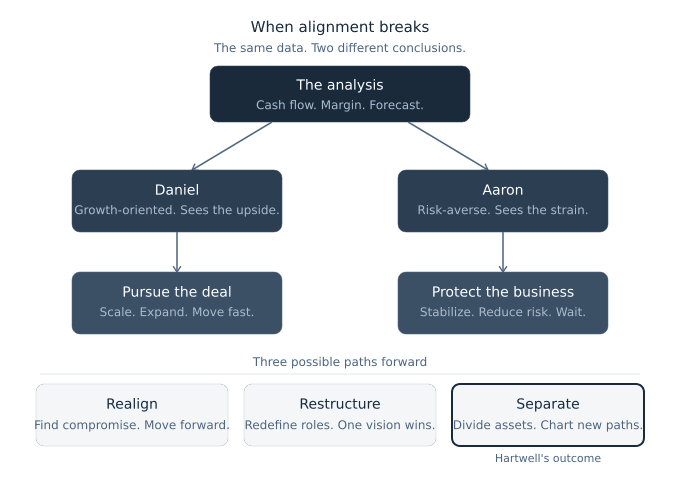
This didn’t end in a clean turnaround story where everyone aligned, executed, and doubled margins. It ended in a business divorce. Daniel and Aaron went their separate ways. Segments of the business were split and restructured accordingly.
It’s not an outcome anyone aims for. But it’s a real one. And Hartwell isn’t the only company I’ve worked with where this happened. I can quickly name at least a half-dozen others, and those were just the formal separations. In other cases, the company bleeds into liquidation. Or people just quit.
Over time, I’ve come to see this not as a failure of analysis, but as a consequence of clarity. Sometimes the most honest thing an advisor can do is surface a misalignment that was always there but was never fully confronted.
The numbers told one story. Leadership believed another. And eventually, a choice had to be made.
Lessons Worth Keeping
There were a number of takeaways from Hartwell Toys and from other companies facing similar growing pains.
1. Revenue rarely fixes operating dysfunction.
I’m currently reading The Accounting Game with my kids. It simplifies accounting and finance by illustrating concepts through a lemonade stand business – a most common small business venture that kids pursue.
But ‘real’ companies aren’t lemonade stands. Selling more doesn’t automatically solve underlying issues. In fact, it often amplifies them. Additional revenue can temporarily mask problems, but if root causes aren’t addressed, they resurface. And they’re usually under greater strain. Tools and systems won’t fix that either. They’ll just make the problems more visible.
2. Gross margin is a starting point, not a conclusion.
When you fully allocate the real costs of serving a product, customer, or channel — engineering time, quality control, service burden, carrying costs — the economics often look very different. The P&L tells part of the story. Cash flow fills in the gaps. Together, they provide a clearer picture of how the business actually operates.
3. The math isn’t complicated. The will to act on it is.
When leadership teams hold fundamentally different visions for a business, the data will eventually make that tension undeniable. At that point, the role of FP&A isn’t to take sides. It’s to ensure decisions are made with clarity, grounded in complete information, by the people responsible for the outcome.
When teams are aligned around the facts, even difficult decisions become more straightforward. I can’t say it makes them easier but it does make them much more objective and harder to dig into hunches.
That’s the advantage of strong FP&A — not just better reporting, but a clearer path forward.